



What's Happening?
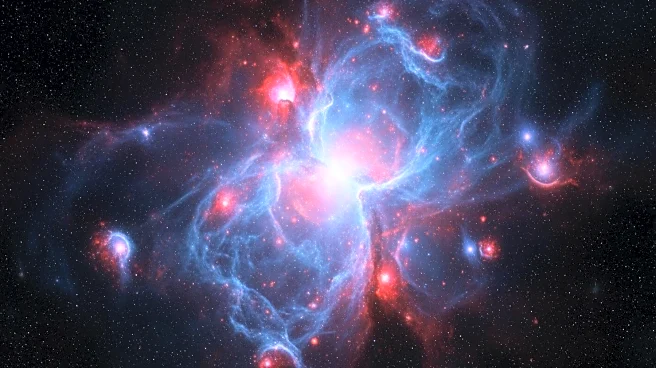
The James Webb Space Telescope (JWST) has captured a detailed image of the Sagittarius B2 (Sgr B2) molecular cloud, a massive star-forming region located approximately 26,000 light-years from Earth in the constellation Sagittarius. This cloud, one of the largest
in the galaxy, has a mass between 3 million and 10 million times that of the sun and spans 150 light-years. The JWST's Mid-Infrared Instrument (MIRI) revealed clumps of dust and gas glowing in shades of pink, purple, and red, surrounded by dark areas where dense dust blocks light. Sgr B2 is noted for its chemical richness, containing several complex molecules, and is responsible for forming half of the stars in the Milky Way's central region, despite containing only 10% of the galactic center's gas. This discovery may provide insights into the cloud's unusual efficiency in star formation.
Why It's Important?
The discovery of the Sgr B2 molecular cloud by the James Webb Space Telescope is significant for several reasons. It offers astronomers a unique opportunity to study one of the most chemically complex and efficient star-forming regions in the Milky Way. Understanding why Sgr B2 is more efficient at star formation than other parts of the galactic center could provide valuable insights into the processes that govern star formation in our galaxy. This knowledge could have broader implications for our understanding of galaxy formation and evolution. Additionally, the chemical richness of Sgr B2 may help scientists identify the building blocks of life and understand the conditions necessary for life to develop elsewhere in the universe.
What's Next?
Future observations and analyses of the Sgr B2 molecular cloud are expected to focus on the masses and ages of the stars within this region. By studying these characteristics, astronomers hope to gain further insights into the mechanisms of star formation in the Milky Way's center. The James Webb Space Telescope will continue to play a crucial role in these investigations, providing high-resolution images and data that can help unravel the mysteries of this and other star-forming regions. The findings could influence future research directions and potentially lead to new discoveries about the origins of stars and planetary systems.
Beyond the Headlines
The study of the Sgr B2 molecular cloud also raises questions about the potential for life in other parts of the universe. The presence of complex molecules in such a chemically rich environment suggests that the building blocks of life may be more common than previously thought. This discovery could prompt further exploration of similar regions in the galaxy, as scientists seek to understand the conditions that lead to the formation of life. Additionally, the efficiency of star formation in Sgr B2 may challenge existing models of star formation, leading to revisions in our understanding of how stars and planets form and evolve over time.