
What's Happening?
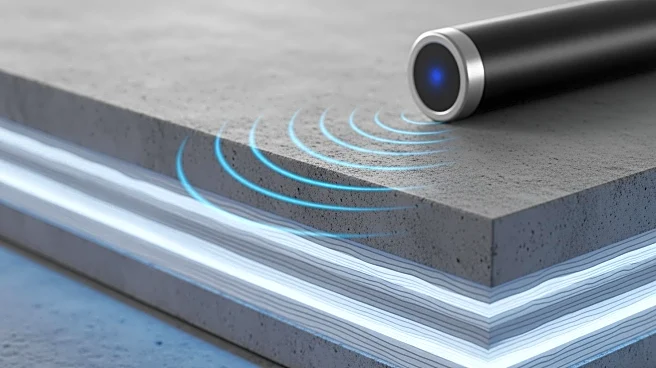
Researchers from Tohoku University, Los Alamos National Laboratory, and Texas A&M University have developed a high-resolution 3D ultrasonic imaging technique for concrete analysis. This system automatically
adapts to diverse concrete structures, improving the detection of internal flaws without causing damage. The technique uses a broadband ultrasonic wave and a laser Doppler vibrometer to capture a wide range of frequencies, enhancing the contrast between defects and background material. This innovation allows for more accurate and efficient maintenance and repair planning for concrete structures such as highways and bridges.
Why It's Important?
The development of this ultrasonic system is significant for infrastructure safety and maintenance. By providing a clearer and more detailed view of internal defects in concrete, the system enables more precise repair planning, potentially extending the lifespan of critical infrastructure. This advancement is particularly important for aging infrastructure in the U.S., where timely maintenance can prevent costly repairs and ensure public safety. The technology also represents a step forward in nondestructive testing methods, which are crucial for maintaining the integrity of essential structures.
What's Next?
The adoption of this ultrasonic imaging system could lead to widespread improvements in infrastructure maintenance practices. As the technology becomes more accessible, it may be integrated into routine inspections of bridges, highways, and other concrete structures. This could result in more proactive maintenance strategies, reducing the risk of structural failures. Additionally, the system's ability to provide detailed 3D maps of defects may influence future design and construction standards, promoting the use of more resilient materials and techniques.
Beyond the Headlines
The introduction of this technology also highlights the importance of interdisciplinary collaboration in engineering and materials science. The successful development of the ultrasonic system involved expertise from multiple fields, demonstrating the value of cross-disciplinary approaches in solving complex engineering challenges. This collaboration could serve as a model for future innovations in infrastructure technology, encouraging partnerships between academia, industry, and government to address pressing societal needs.