









What's Happening?
The Maryland Energy Administration (MEA) has initiated 'Megawatts for Maryland,' a multi-phase competitive auction program designed to expand the state's renewable energy generation and energy storage capacity. This program is backed by up to $100 million
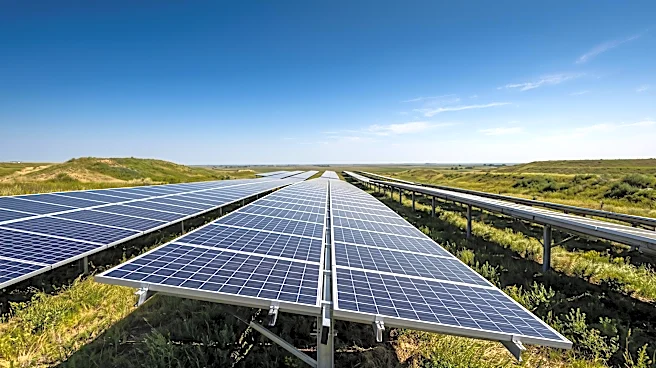
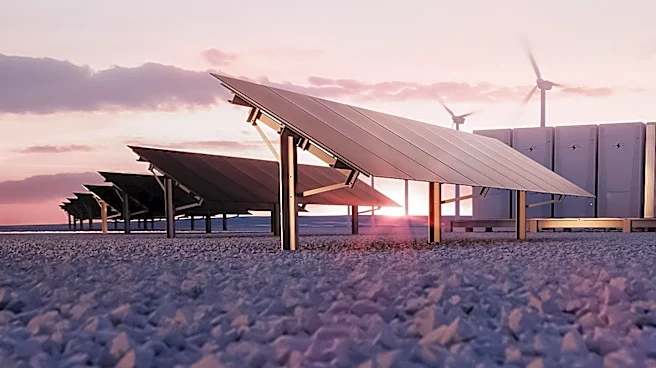
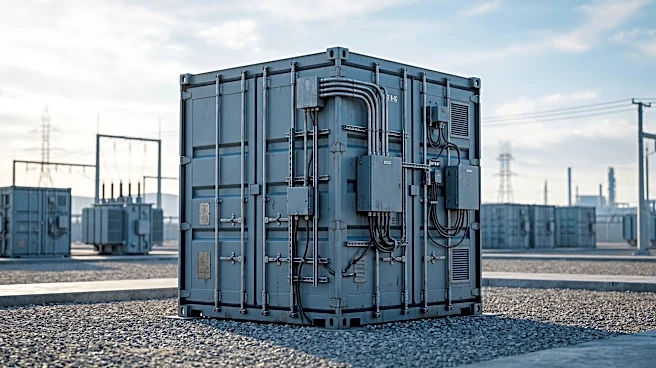
for Fiscal Year 2027, with an additional $100 million anticipated for FY 2028, drawing funds from the state’s Strategic Energy Investment Fund. The initiative aims to address increasing electricity demand and regional transmission cost pressures by focusing on grid-scale deployment. Maryland currently has 3,440 MWdc of installed solar capacity across 119,137 installations, representing $7.7 billion in investment and generating 8.77% of its electricity. Despite powering over 408,000 homes with solar, the state's battery storage capacity is relatively low at 35 MWh, highlighting the need for grid-scale storage incentives. The program is open to Tier 1 renewable energy generation projects not participating in net energy metering, energy storage systems (standalone or co-located), and hybrid assets. Grants will be awarded to developers offering the lowest price per megawatt-hour through a closed-bid auction format.
Why It's Important?
This $200 million grant program is crucial for Maryland's energy future and sets a precedent for other states looking to enhance their renewable energy infrastructure. By incentivizing grid-scale solar and storage, Maryland aims to reduce regional electricity rates and increase energy independence. The program's focus on competitive bidding ensures that public funds are utilized efficiently, supporting projects that offer the best value. The expansion of solar and battery storage capacity will contribute to a more resilient and stable grid, capable of handling peak demands and reducing reliance on traditional, often more expensive, energy sources. This initiative also supports the local economy, as Maryland boasts 200 solar companies, including manufacturers and installers, employing nearly 5,000 people. The projected addition of 2,637 MW of solar capacity over the next five years underscores the significant economic and environmental impact of this program, fostering innovation and job creation within the renewable energy sector.
What's Next?
Developers interested in the 'Megawatts for Maryland' program must establish baseline eligibility by November 30, 2026, through a preliminary application process where the MEA will evaluate project parameters, real estate control, and interconnection standing. Applicants who clear this initial stage will then need to submit their final bid price per megawatt-hour, along with comprehensive financial models and documentation, by January 22, 2027. The MEA expects to issue grant decisions in Spring 2027. Selected projects will be required to achieve commercial operation within seven years of funding allocation. This structured timeline ensures a rigorous selection process, aiming to back projects that are viable and capable of reaching operational status. The program's success could lead to further investments in renewable energy and storage, potentially influencing other states to adopt similar incentive models to meet their clean energy targets.
Beyond the Headlines
The 'Megawatts for Maryland' program signifies a broader shift in how states are approaching renewable energy development, moving beyond individual rooftop solar incentives to focus on grid-scale solutions. This strategic pivot acknowledges the limitations of distributed generation alone and emphasizes the critical role of large-scale storage in stabilizing the grid and integrating higher percentages of intermittent renewable energy. The competitive bidding process, which prioritizes the lowest price per megawatt-hour, reflects a growing maturity in the renewable energy market, where cost-effectiveness is becoming as important as environmental benefits. This approach could accelerate technological advancements in energy storage and large-scale solar deployment, fostering a more robust and competitive market. Furthermore, by reducing the need for new utility-scale generation, such programs can lead to long-term savings for all electricity consumers, highlighting the economic benefits of proactive renewable energy policies.