
What's Happening?
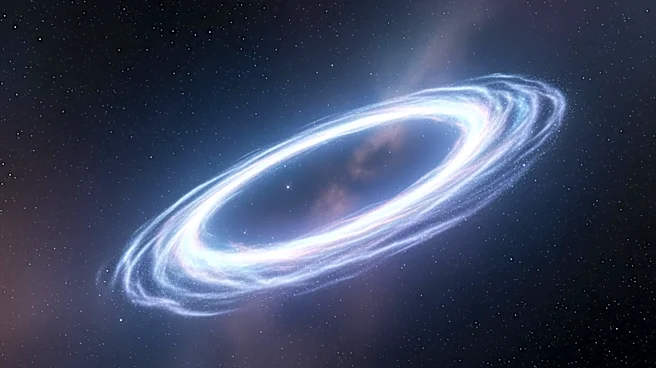
Astronomers have identified a ring-shaped region beyond Jupiter's orbit that appears to function as a 'planet factory.' This area is packed with gas and dust, which may serve as a breeding ground for planetesimals—solid
masses that can become the building blocks of planets. According to a study published in The Astrophysical Journals, computer simulations have shown that this region produces planetesimals of varying compositions, making it a significant planet-forming area in our solar system. The discovery provides insights into the origins of carbonaceous chondrites, a class of planetesimals that formed millions of years after the solar system's inception. These planetesimals are thought to have been ejected as the solar system matured, but traces survive as meteorite fragments on Earth. The study suggests that a 'dust trap' beyond Jupiter created a ring of higher pressure gas, trapping dust grains that clumped into pebbles, eventually forming planetesimals.
Why It's Important?
This discovery is crucial for understanding the solar system's evolution and the formation of planets. The findings suggest that dust traps were the preferred birthplace of planetesimals, offering a new perspective on planetary formation theories. The research underscores Jupiter's role in shaping the solar system by acting as a barrier for larger particles, influencing the composition and formation of planetesimals. These insights could refine models of how planets form and evolve, impacting our understanding of planetary systems beyond our own. The study also highlights the importance of computer simulations in reproducing laboratory studies of meteorites, providing a touchstone for theories of planetary formation.
What's Next?
Further research and simulations are likely to explore the dynamics of dust traps and their role in planet formation. Scientists may investigate other regions in the solar system to identify similar planet-forming areas. The study's findings could lead to new models of planetary formation, influencing future space exploration missions aimed at understanding the origins of planets and meteorites. Collaboration between astronomers and cosmochemists will be essential to validate these findings and explore their implications for planetary science.
Beyond the Headlines
The discovery of a 'planet factory' challenges traditional views of planet formation, suggesting that regions beyond major planets like Jupiter play a significant role in the solar system's development. This could lead to a reevaluation of how we understand the formation of planets and their building blocks. The study also raises questions about the potential for similar processes in other planetary systems, offering a broader perspective on the universe's evolution. Ethical considerations may arise regarding the prioritization of space exploration resources to study these phenomena.