








What's Happening?
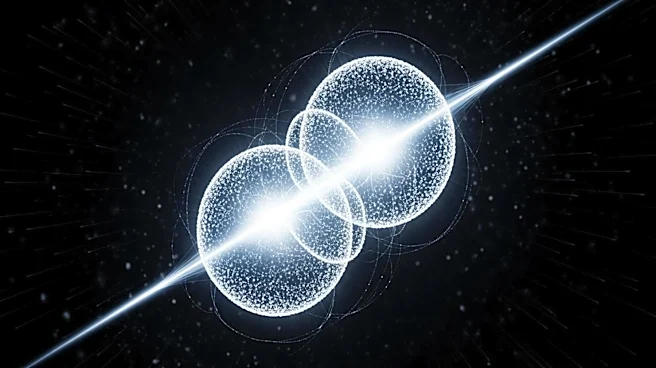
Physicists at the Australian National University have successfully observed quantum entanglement in helium atoms, marking a significant advancement in quantum physics. This experiment involved splitting a cloud of helium atoms, which then scattered and
fell under gravity while maintaining entangled states. This phenomenon, previously observed in photons, is more challenging to demonstrate in atoms due to their mass and the influence of gravity. The research team, led by Dr. Sean Hodgman, utilized ultracold metastable helium atoms and a Bose-Einstein condensate to achieve this result. By using laser pulses, they manipulated the atoms into different momentum states, creating entangled pairs with opposite momenta. This experiment provides a new platform for testing quantum mechanics in massive particles, potentially bridging the gap between quantum mechanics and general relativity.
Why It's Important?
This discovery is crucial for the field of quantum physics as it opens new avenues for exploring the intersection of quantum mechanics and gravity. Atoms, unlike massless photons, interact with gravitational fields, making them ideal candidates for experiments that test the principles of quantum mechanics in the context of general relativity. The ability to observe entanglement in massive particles could lead to advancements in quantum sensing and imaging technologies, offering precision beyond current limits. Furthermore, this research lays the groundwork for future studies that could address fundamental questions about the universe, such as the reconciliation of quantum mechanics with gravitational forces.
What's Next?
The research team plans to refine their experimental setup to perform more stringent tests, such as the CHSH-Bell inequality test, which requires independent phase settings in spatially separated regions. Achieving this would involve enhancing the detector's capabilities to allow for greater separation of entangled atom pairs. Future experiments may also explore the use of helium isotopes with varying masses to test the weak equivalence principle in quantum systems. These advancements could significantly contribute to our understanding of quantum mechanics and its application to real-world phenomena.