







What's Happening?
Researchers at the Icahn School of Medicine at Mount Sinai have conducted a study exploring the feasibility of using AI with wearable devices to predict prolonged periods of inactivity in women with chronic pelvic pain. The study, published in the journal
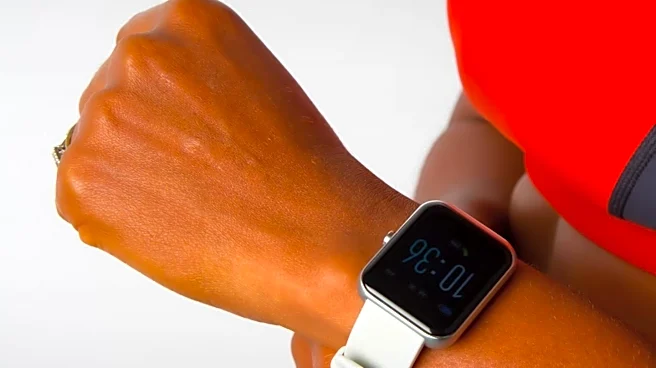
Women’s Health, involved 134 women with chronic pelvic pain and 61 healthy women as a control group. Participants wore Fitbit devices for up to 90 days, collecting minute-by-minute data on physical activity, heart rate, steps, and sleep patterns. The research team developed personalized forecasting models to predict activity levels one hour in advance, aiming to identify 15-minute windows for 'exercise snacks'—short activity breaks. Lead author Jannes Jegminat, PhD, noted the surprising effectiveness of simpler AI models in forecasting sedentary behavior, suggesting that complex AI is not always necessary. The study's primary goal was to determine if wearable devices could act as an early-warning system for prolonged sitting, allowing for timely, personalized movement prompts.
Why It's Important?
This research holds significant implications for individuals with chronic pain, who often face a paradox: increased risk for sedentary behavior due to pain, despite demonstrated health benefits from increased physical activity. The ability of AI to predict sedentary periods could enable proactive interventions, potentially improving symptom relief and overall quality of life. By focusing on 'exercise snacks,' the approach offers a more realistic and achievable method for increasing physical activity, especially for those for whom longer exercise periods are challenging. The study also highlights the potential for lightweight, interpretable AI models to run directly on personal devices, which could enhance privacy and practical application. If successful, this technology could transform how chronic pain is managed, shifting from reactive advice to predictive, personalized support, thereby reducing the health risks associated with prolonged sitting.
What's Next?
Further research is needed to determine if delivering personalized movement prompts based on these AI predictions actually helps reduce sedentary time, improves symptoms, and enhances quality of life. Ipek Ensari, PhD, who studies AI and human health, emphasized that these questions will require prospective clinical trials. The current study did not investigate whether participants would actually respond to the prompts by getting up and moving. Additionally, there has been no consultation with pain patients regarding their willingness to use or desire for such technology. Researchers acknowledge the need for patient input to ensure the technology is both wanted and effective. Future steps will involve clinical trials to validate the efficacy of these AI prompts in real-world scenarios and to address the practical application of the technology during necessary sedentary periods, such as work or rest.
Beyond the Headlines
The study touches upon broader ethical and practical considerations regarding the integration of AI into personal health management. While the potential for AI to improve health outcomes for chronic pain patients is significant, questions arise about user autonomy and the potential for 'prompt fatigue.' The concern about receiving movement notifications during necessary sedentary activities, such as driving or working, highlights the need for AI systems to be context-aware and highly personalized to avoid being intrusive or counterproductive. The researchers' observation that simpler AI models performed well challenges the notion that more complex AI is always superior, suggesting a path toward more accessible and privacy-preserving health technologies. This research also underscores the growing trend of AI in healthcare and the critical importance of patient consultation in the development and deployment of such tools to ensure they meet genuine needs and are adopted effectively.