



What's Happening?
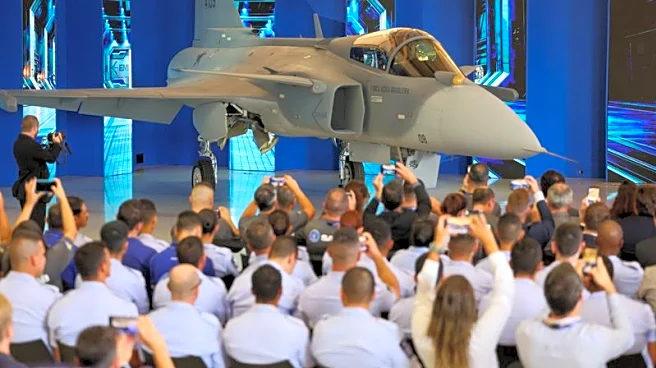
South Korea has officially commenced the serial production of its indigenous fighter jet, the KF-21 Boramae, marking a significant milestone in its aerospace ambitions. The KF-21, developed by Korea Aerospace Industries (KAI) in collaboration with national
defense agencies, represents a major step towards defense self-reliance. The program, which began over 25 years ago, aims to reduce South Korea's dependence on foreign military suppliers. The KF-21 is classified as a 4.5-generation fighter, featuring advanced avionics and a reduced radar signature. It is designed for air superiority and multirole missions, offering a balance of performance and cost-effectiveness. The first series-produced aircraft was unveiled in Sacheon, with President Lee Jae Myung attending the ceremony. The jet is expected to undergo performance verification and flight validation before entering operational service later this year.
Why It's Important?
The mass production of the KF-21 Boramae signifies South Korea's emergence as a significant player in the global aerospace industry. This development enhances the country's defense capabilities and positions it as a potential exporter of advanced military technology. The KF-21's competitive features and cost-effectiveness make it an attractive option for countries looking to modernize their air forces without the high costs associated with fifth-generation stealth fighters. Indonesia, a partner in the program, is expected to be the first export customer, highlighting the jet's international appeal. The success of the KF-21 program could lead to increased economic growth and technological advancement in South Korea, strengthening its position in the global defense market.
What's Next?
As the KF-21 enters mass production, South Korea will focus on completing performance verification and flight validation to ensure the aircraft meets operational standards. The country aims to deploy the jet in its air force by the end of the year. Additionally, South Korea will likely pursue further export opportunities, leveraging the KF-21's capabilities to attract international buyers. Continued investment in aerospace innovation and collaboration with partner nations is expected to follow, as South Korea seeks to expand its influence in the global defense industry. The successful deployment and export of the KF-21 could pave the way for future advancements in South Korea's military technology sector.