


What's Happening?
A new study led by UCLA astrophysicists, published in AAS Journals, indicates that stellar collisions were frequent in the early universe due to extremely dense stellar systems. These collisions, occurring at varying speeds, either destroyed stars or
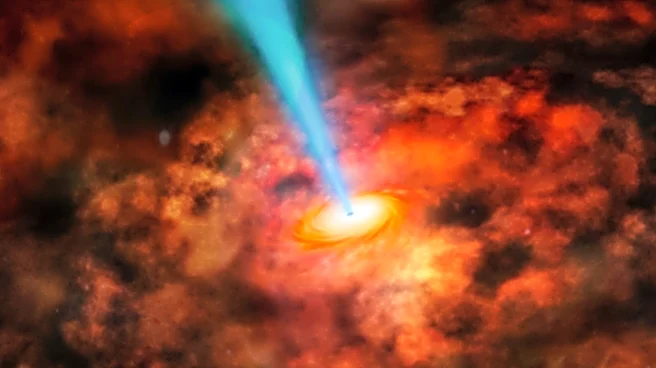
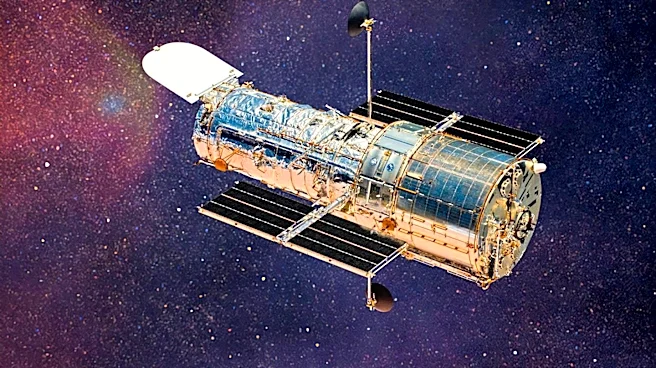
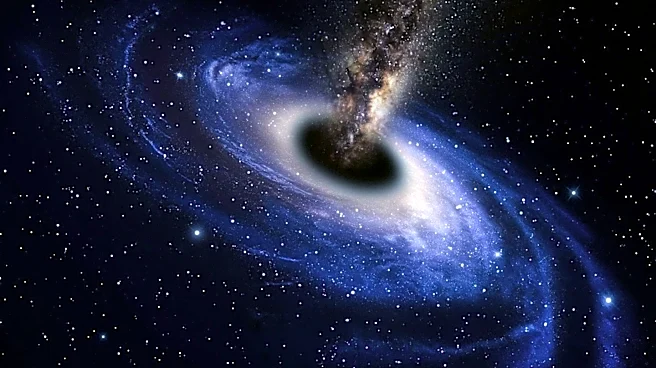
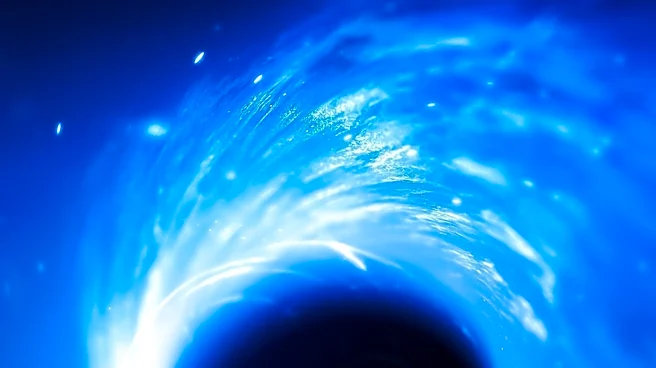
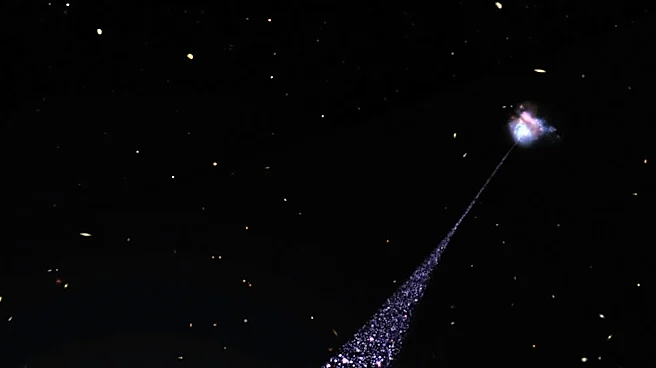
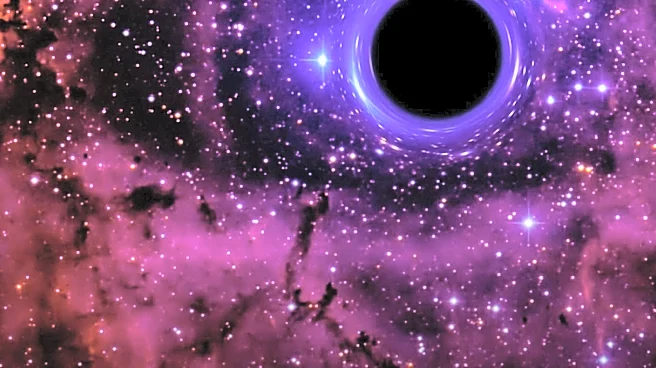
caused them to merge, potentially forming single, extraordinarily massive stars. Some of these gigantic stars are believed to have eventually collapsed into black holes. This finding offers a potential explanation for the rapid formation of supermassive black holes observed in the young universe by the James Webb Space Telescope. UCLA doctoral student Claire Williams, the corresponding author, noted that repeated mergers could create a star with a mass equivalent to an entire cluster, which would then collapse into a massive black hole. The research suggests that intriguing 'little red dots' (LRDs) observed in the early universe might be dense star clusters undergoing these stellar collisions, leading to the formation of large stars that become black holes.
Why It's Important?
This research is crucial for resolving a long-standing mystery in astrophysics: how supermassive black holes formed so early in the universe's history. Traditional models suggested a gradual growth, but observations from the James Webb Space Telescope have shown their presence much earlier than expected. By proposing stellar collisions within dense star clusters as a primary mechanism, the study provides a viable pathway for the rapid creation of massive black hole 'seeds.' This understanding impacts our models of galaxy formation and evolution, as supermassive black holes are central to these processes. The study also connects theoretical models with observational data, such as the 'little red dots,' offering a more comprehensive picture of the early universe's extreme conditions and their role in shaping cosmic structures.
What's Next?
The findings from this study will likely spur further observational and theoretical work. Astronomers will continue to use telescopes like the James Webb Space Telescope to search for more 'little red dots' and other evidence of dense star clusters and stellar collisions in the early universe. Future simulations will aim to refine the models of stellar mergers and black hole formation within these extreme environments, potentially exploring different initial conditions and their outcomes. The research also opens avenues for investigating the properties of intermediate-mass black holes, an elusive type that may be more common in such dense clusters. Continued efforts will focus on integrating these findings with other cosmological models to build a more complete narrative of the universe's early development.
Beyond the Headlines
The concept of frequent stellar collisions in the early universe paints a vivid picture of a far more dynamic and violent cosmic past than previously imagined. This extreme environment, characterized by rapid star formation and gravitational interactions, was fundamentally different from the more quiescent universe we observe today. The study's implications extend beyond black hole formation, touching upon the origins of galactic structures and the distribution of elements. Understanding these early processes helps us appreciate the intricate chain of events that led to the formation of galaxies like our own Milky Way, with its own supermassive black hole at the center. It also highlights the power of modern astronomical tools and computational modeling in unraveling the universe's deepest secrets.