





What's Happening?
Robert Suarez, a Singularity expert, emphasizes that biology represents the largest dataset ever, containing four billion years of evolutionary experimentation. This perspective is detailed in the report 'Living Tech: The Convergence of Biology and Innovation.'
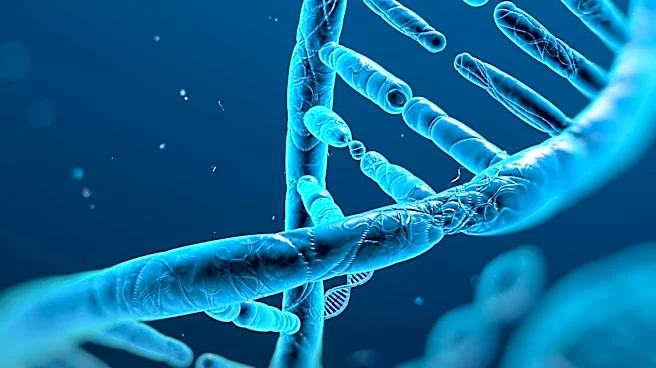
Advances in biotechnology, including genome sequencing, gene expression monitoring, neural mapping, and cellular tracking, are transforming the living world into analyzable information for computers. This shift allows for a deeper understanding of biological systems that were previously inaccessible through direct observation. The ability to computationally analyze biological processes, exemplified by tools like Google DeepMind's AlphaFold, which predicts protein structures with extraordinary speed, is revolutionizing how researchers approach innovation. Instead of merely observing nature, scientists can now use computational tools to narrow down research fields, identify patterns, and guide investigations, effectively searching nature's vast knowledge base.
Why It's Important?
This development is crucial because it fundamentally alters the approach to innovation across various U.S. industries. By treating biology as a massive, searchable dataset, researchers can move beyond traditional biomimicry—simply copying natural designs—to actively querying nature for solutions to complex problems. This paradigm shift has implications for fields far beyond biotechnology, such as manufacturing, computing, agriculture, architecture, and neuroscience. For instance, understanding how slime mold optimizes transportation networks or how organisms manage heat can inform the design of more efficient data centers. The ability to analyze biological strategies for thermal regulation or information storage (like DNA's capacity) could lead to breakthroughs in energy efficiency and data management, impacting technology companies and infrastructure development. This convergence of biology and technology promises to unlock novel solutions and drive innovation by leveraging nature's proven strategies.
What's Next?
The ongoing advancements in biotechnology and artificial intelligence are expected to further enhance our ability to 'read' and 'search' biological data. Future developments will likely focus on refining computational tools to analyze increasingly complex biological systems, leading to more precise and efficient innovation. This could involve the development of new AI models that can predict biological interactions with greater accuracy or tools that can simulate evolutionary processes to identify optimal solutions. Stakeholders in technology, pharmaceutical, and materials science industries will likely invest more in interdisciplinary research that combines biological insights with engineering and computer science principles. The long-term trajectory points towards a future where biological systems themselves, through synthetic biology, become integral components of technology, moving from learning from biology to actively building with it. This could lead to the creation of new materials, manufacturing processes, and even data storage mediums based on biological principles.
Beyond the Headlines
The deeper implications of treating biology as a searchable dataset extend to ethical and philosophical considerations about humanity's relationship with nature. As we gain the ability to not just understand but also manipulate biological processes with increasing precision, questions arise about the boundaries of intervention and the potential for unintended consequences. The concept of 'phytomining,' where genetically enhanced plants could recover valuable metals, highlights the potential for environmental benefits but also raises concerns about ecological disruption. Furthermore, the ability to apply engineering principles to the building blocks of life, as described in synthetic biology, blurs the lines between natural and artificial. This shift could trigger long-term societal debates about the definition of life, the ethics of genetic modification, and the responsible stewardship of biological resources, impacting public policy and cultural norms surrounding scientific advancement.