






What's Happening?
PsiQuantum, a company focused on building fault-tolerant quantum computers, has secured significant funding from the U.S. government. In 2026, the U.S. Department of Commerce signed a $100 million Letter of Intent under the CHIPS and Science Act. This
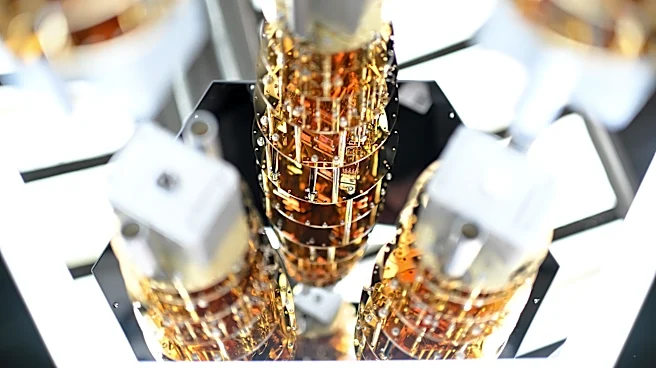
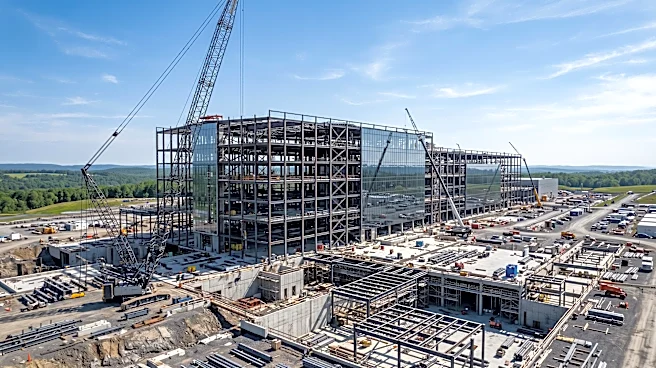
was followed by a $125 million agreement with DARPA under Stage C of its Quantum Benchmarking Initiative, marking PsiQuantum's most substantial U.S. government agreement to date. The company's approach is based on silicon photonics, leveraging advanced semiconductor manufacturing processes. Photonics offers advantages for scalability, as photons are immune to electromagnetic interference and integrate with existing cryogenic cooling and fiber-optic infrastructure. PsiQuantum's technology has undergone rigorous scrutiny by the U.S. government for emerging technologies. The company also closed a $1 billion funding round in 2025, valuing it at $7 billion, and has begun construction on a utility-scale quantum computer in Brisbane, Australia, while expanding its Chicago site.
Why It's Important?
This substantial U.S. government investment underscores the strategic importance of quantum computing for national interests and technological leadership. The funding, particularly through the CHIPS and Science Act and DARPA, highlights a concerted effort to accelerate the development of advanced computing capabilities within the U.S. PsiQuantum's silicon photonics approach, which integrates with existing semiconductor manufacturing, could provide a pathway to scalable quantum computers, potentially transforming industries such as energy, pharmaceuticals, finance, and transportation. The U.S. government's backing helps de-risk the technology for private investors and signals confidence in PsiQuantum's ability to deliver on its promise of fault-tolerant quantum systems. This could position the U.S. at the forefront of quantum technology, creating new economic opportunities and strengthening its competitive edge in the global tech landscape.
What's Next?
PsiQuantum is expected to continue its development and deployment efforts, with the U.S. government agreements providing a stable financial foundation. The company's ongoing construction of a utility-scale quantum computer in Brisbane, Australia, and expansion of its Chicago site indicate a clear path toward operationalizing its technology. Future developments will likely involve further advancements in silicon photonics, cryogenic cooling integration, and the development of algorithms and software to maximize the commercial value of these quantum systems. The continued collaboration with U.S. government agencies like DARPA suggests ongoing evaluation and benchmarking of their quantum computing capabilities, which could lead to further contracts and support as the technology matures.
Beyond the Headlines
The U.S. government's investment in PsiQuantum reflects a broader strategic imperative to secure leadership in critical emerging technologies. Quantum computing is not merely an incremental improvement over classical computing; it represents a fundamental shift with the potential to solve problems currently intractable for even the most powerful supercomputers. This investment also highlights the intersection of national security and technological innovation, as quantum capabilities could have profound implications for cryptography, defense, and intelligence. The emphasis on silicon photonics also points to a strategy of leveraging existing semiconductor infrastructure, which could accelerate development and reduce costs compared to entirely novel approaches. This could also foster a new ecosystem of quantum-related industries and skilled labor within the U.S.