



What's Happening?
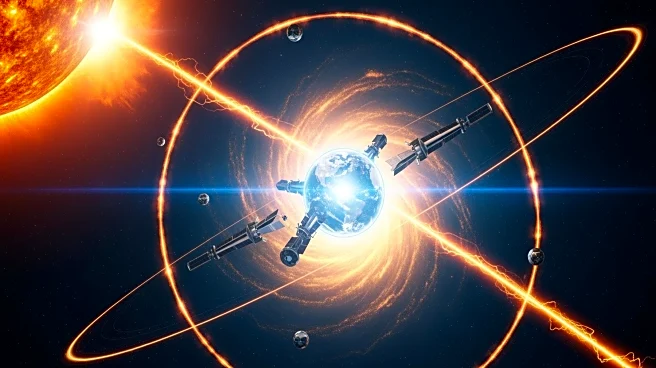
A recent study highlights the potential for satellite collisions in Earth's orbit following severe solar storms. The research, published on arXiv, introduces the 'Crash Clock,' a model predicting that the first collision could occur in less than three
days if satellites lose their ability to avoid each other. This scenario could lead to a cascade of collisions, making space around Earth unusable. The study emphasizes the increased risk due to the growing number of satellites, particularly in low Earth orbit, where megaconstellations like SpaceX's Starlink operate. The findings underscore the fragility of space operations, especially during solar events that increase atmospheric drag on satellites, complicating trajectory predictions.
Why It's Important?
The study raises significant concerns about the sustainability of space operations as the number of satellites continues to grow. A collision cascade could disrupt global communications, navigation, and other satellite-dependent services, impacting industries and economies worldwide. The potential for such events highlights the need for improved space traffic management and collision avoidance strategies. The findings also stress the importance of international cooperation in space governance to prevent a scenario where space becomes too hazardous for operations, threatening the future of space exploration and commercial activities.
What's Next?
The study suggests that satellite operators can mitigate risks by de-orbiting old satellites and carefully planning new launches. As the space industry continues to expand, with projections of tens of thousands more satellites by 2035, the need for robust collision avoidance systems and international regulatory frameworks becomes more pressing. The research calls for a reevaluation of current practices to ensure the long-term sustainability of space activities, urging stakeholders to prepare for potential solar storms that could trigger catastrophic collision events.