




What's Happening?
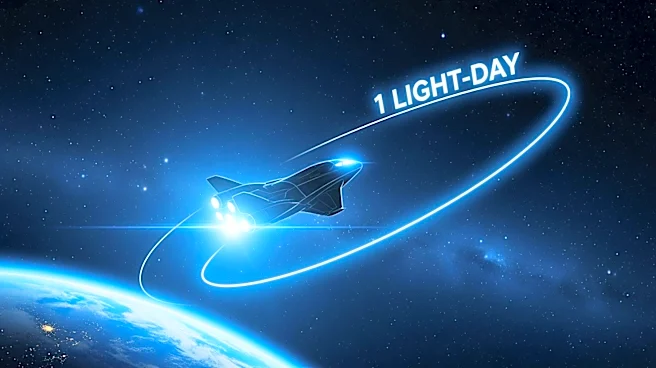
NASA's Voyager 1 spacecraft is set to become the first human-made object to travel a full light-day from Earth by January 28, 2027. Launched in 1977, Voyager 1 was initially tasked with exploring the outer planets, but it has since surpassed its original
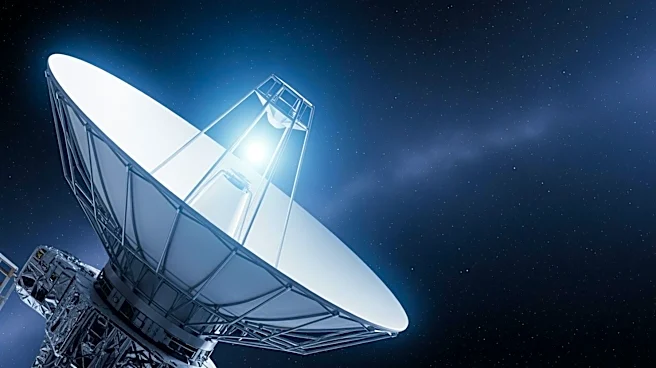
mission, venturing into interstellar space. Currently, the spacecraft is over 166 Astronomical Units (AU) away from Earth, traveling at a speed of approximately 61,195 km/h. A light-day, the distance light travels in 24 hours, is about 25.9 billion kilometers. Voyager 1 is expected to reach this milestone in late 2026, marking a significant achievement in space exploration. Despite its distance, it still communicates with Earth, although signals take over 23 hours to reach the spacecraft.
Why It's Important?
This milestone underscores the vastness of space and the progress of human exploration beyond our Solar System. Voyager 1's journey highlights the potential for future interstellar exploration and the technological advancements that have made such missions possible. The spacecraft's continued operation and data transmission provide valuable insights into the outer reaches of our Solar System and beyond. As Voyager 1 approaches the limits of the Sun's gravitational influence, it offers a unique opportunity to study the boundary of interstellar space, contributing to our understanding of the cosmos. This achievement also serves as a testament to the durability and success of NASA's Voyager program.
What's Next?
Voyager 1 will continue its journey into interstellar space, with NASA estimating that it will send data back to Earth until the early 2030s. After that, communication will cease, but the spacecraft will keep traveling indefinitely. This ongoing mission may inspire future projects aimed at exploring even further into space. The data collected by Voyager 1 will continue to be analyzed, potentially leading to new discoveries about the interstellar medium and the boundary of our Solar System. As the spacecraft moves beyond the Oort Cloud, it will provide a historical marker of humanity's first steps into interstellar exploration.
Beyond the Headlines
Voyager 1's journey raises questions about the future of space exploration and the potential for human-made objects to reach other star systems. The mission challenges us to consider the long-term implications of interstellar travel and the technological innovations required to sustain such endeavors. It also highlights the importance of international collaboration in space exploration, as the data and findings from Voyager 1 are shared globally, contributing to a collective understanding of our place in the universe. The mission's success may pave the way for future explorations that could one day lead to human travel beyond our Solar System.