




What's Happening?
Astronomers have reinterpreted the unusual light signature of gamma-ray burst (GRB) GRB 260310A, initially detected by NASA’s Fermi Gamma-ray Space Telescope on March 10, 2026. This GRB exhibited a weak initial gamma-ray flash, followed by a gradual brightening
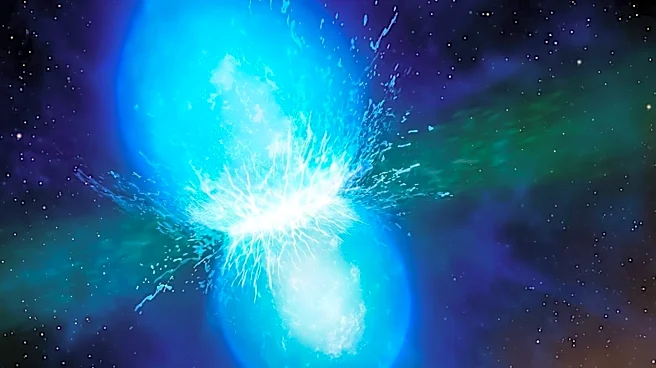
of its visible light afterglow and a late-time rebrightening in X-rays. An international team of researchers, led by Yu-Han Yang of the University of Rome Tor Vergata, published their findings in The Astrophysical Journal Letters, suggesting that the peculiar behavior is best explained by an 'off-axis' viewing angle of a 'two-component jet.' Unlike most GRBs observed head-on, GRB 260310A was viewed from the side, revealing a complex jet structure with a bright inner core and a dimmer outlying sheath. This model accounts for the initial dimness and the subsequent, unusually bright afterglows in X-ray, optical, and radio bands.
Why It's Important?
This reinterpretation of GRB 260310A significantly advances our understanding of gamma-ray bursts, which are among the most energetic events in the universe. By demonstrating that a GRB's apparent brightness and light curve can be heavily influenced by the viewing angle and the internal structure of its jets, this research challenges previous assumptions based primarily on head-on observations. This has implications for how astronomers estimate the true energy output and frequency of GRBs, potentially leading to a revised understanding of the universe's most powerful explosions. The study, involving NASA instruments like the Chandra X-ray Observatory, highlights the importance of multi-wavelength observations and sophisticated modeling to unravel complex astrophysical phenomena, contributing to the broader field of high-energy astrophysics.
What's Next?
The findings from GRB 260310A will prompt astronomers to re-examine other 'oddball' GRBs that did not fit conventional models, potentially leading to a more comprehensive classification of these events. Future GRB observations will likely incorporate the two-component jet and off-axis viewing models into their analysis, improving the accuracy of energy estimations and the understanding of jet physics. The late-time rebrightening observed in GRB 260310A presents a critical test for the two-component jet model, and further research will focus on refining these models to explain such complex behaviors. Continued use of advanced telescopes and observatories, including those from NASA, will be crucial for gathering more detailed data on GRB afterglows across various wavelengths, helping to confirm and expand upon these new insights into cosmic explosions.
Beyond the Headlines
The study of GRBs, like GRB 260310A, offers a window into the extreme physics of the universe, including the formation of neutron stars and black holes. The concept of an 'off-axis' view transforming an 'unremarkable' event into a 'monster explosion' underscores the subjective nature of observation in astronomy and the need for robust theoretical frameworks. This research also highlights the continuous evolution of scientific understanding, where initial interpretations are refined as more data and sophisticated models become available. The collaborative effort of international researchers and the use of multiple advanced instruments exemplify the global nature of modern scientific inquiry. Understanding these cosmic phenomena contributes to our fundamental knowledge of the universe's most violent processes and the conditions under which matter and energy behave in extraordinary ways.