



What's Happening?
A recent study led by Dr. Valentin Bickel from the Center for Space and Habitability at the University of Bern, in collaboration with researchers from the Astronomical Observatory of Padua, has provided new insights into Mercury's geological activity.
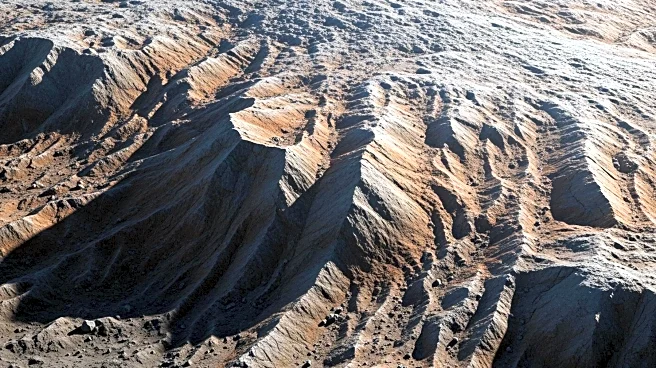
The research focused on the analysis of slope streaks, or 'lineae,' on Mercury's surface, which are believed to be caused by the outgassing of volatile materials. Using machine learning, the team systematically mapped these lineae, revealing that they are primarily found on sun-facing slopes of young impact craters. This suggests that solar radiation plays a significant role in their formation. The study indicates that Mercury is still geologically active, challenging the previous perception of the planet as a static, 'dead' world.
Why It's Important?
The findings of this study are significant as they reshape the understanding of Mercury's geological dynamics. The presence of active outgassing suggests that Mercury is losing volatile materials, which has implications for its geological history and current state. This research could influence future missions to Mercury, such as the BepiColombo mission by the European Space Agency and the Japan Aerospace Exploration Agency, which aims to gather more data on the planet's surface and atmosphere. Understanding Mercury's volatile budget is crucial for comprehending its evolution and the processes that continue to shape it.
What's Next?
The BepiColombo mission, currently en route to Mercury, is expected to provide new images and data that will help verify the study's findings. Researchers plan to use these images to examine the regions with lineae more closely, aiming to determine if new streaks have formed since the last observations by NASA's MESSENGER probe. This ongoing research will enhance the understanding of Mercury's geological processes and the role of volatiles in its activity.