






What's Happening?
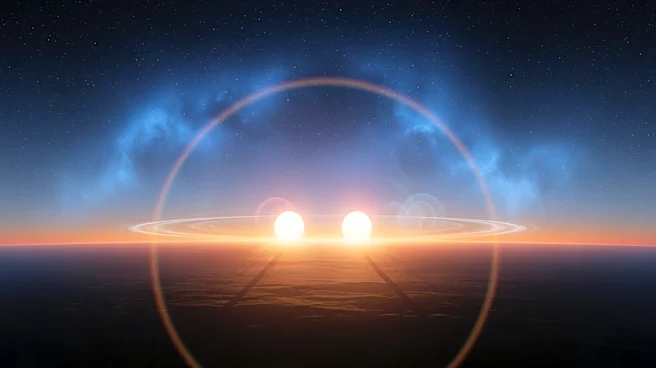
Astronomers have long anticipated finding numerous planets orbiting binary star systems, yet only 14 such planets have been confirmed out of over 6,000 known exoplanets. This discrepancy has puzzled scientists, as binary stars are common and planet formation
is expected to occur frequently. Recent research published in The Astrophysical Journal Letters suggests that Einstein's general relativity may play a role in this phenomenon. Observations from missions like Kepler and TESS have highlighted a significant gap, with Kepler identifying about 3,000 eclipsing binary systems but only 47 planet candidates in those environments. The study indicates that the gravitational dynamics in these systems, influenced by general relativity, lead to orbital instabilities that either eject planets from the system or cause them to be absorbed by the stars.
Why It's Important?
The findings have significant implications for our understanding of planetary formation and stability in binary star systems. The research suggests that the gravitational interactions in these systems, governed by Einstein's theory, create a hostile environment for planet survival. This could reshape the search for exoplanets, as it highlights the need to consider gravitational dynamics when predicting planet locations. The study also underscores the enduring relevance of Einstein's general relativity in modern astrophysics, as it continues to influence celestial phenomena. For astronomers, this means adjusting models and expectations regarding where planets might be found, potentially redirecting future observational efforts.
What's Next?
Future research will likely focus on refining models of planetary formation and stability in binary star systems, taking into account the gravitational effects described in the study. Astronomers may also seek to identify additional circumbinary planets that have managed to survive these harsh conditions, potentially using advanced telescopes and observational techniques. The study's findings could lead to a reevaluation of data from past missions, as well as influence the design of future missions aimed at discovering exoplanets. Additionally, the research may prompt further theoretical work to explore the broader implications of general relativity on planetary systems.