
What's Happening?
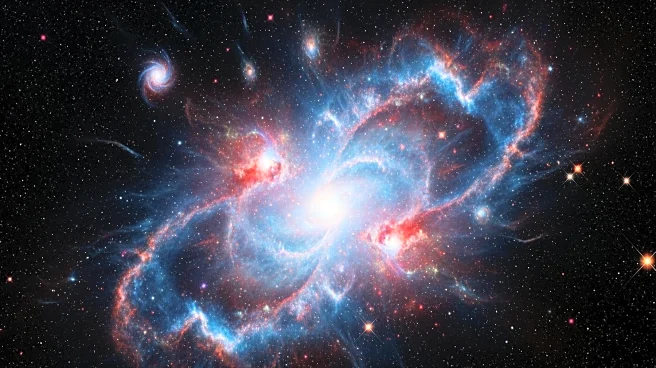
NASA's Hubble Space Telescope has provided a detailed view of the Crab Nebula's expansion over a 25-year period. The Crab Nebula, a supernova remnant, has been observed by Hubble since 1999, with follow-up observations in 2024. The images reveal the nebula's
filaments expanding outward, driven by energy from a pulsar at its core. This pulsar is the dense core of the star that originally went supernova. The observations have been made possible by Hubble's longevity and high resolution, allowing astronomers to study the nebula's chemical and structural changes over time.
Why It's Important?
The study of the Crab Nebula's expansion provides valuable insights into the life cycle of stars and the dynamics of supernova remnants. Understanding these processes is crucial for astronomers as they seek to comprehend the evolution of galaxies and the universe. The data collected by Hubble can help refine models of stellar evolution and the behavior of pulsars. Additionally, the ability to observe such changes over decades highlights the importance of long-term space missions and the technological advancements that enable them.