
What's Happening?
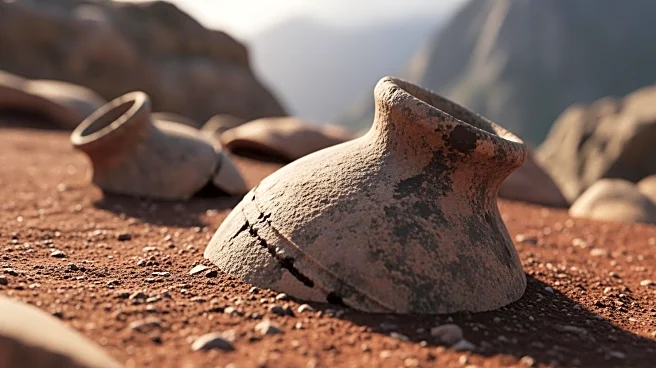
Recent archaeological findings in Turkey have sparked renewed debate over the location of Noah's Ark. Pottery fragments discovered near Mount Ararat have been dated to align with the traditional era associated
with Noah. Professor Faruk Kaya, involved in the research, suggests that these findings could support the historical narrative of Noah's Ark. Ground-penetrating radar (GPR) scans of the area have also provided new insights into the geological formations, which some believe could be remnants of the Ark. This discovery has reignited interest and discussion among archaeologists and historians regarding the validity of the Ark's historical and geographical claims.
Why It's Important?
The discovery of pottery fragments near Mount Ararat is significant as it adds a new dimension to the ongoing debate about the historical and archaeological evidence of Noah's Ark. If the dating of these ceramics is accurate, it could lend credence to the biblical narrative and influence both religious and historical perspectives. This finding may also attract further archaeological exploration and research in the region, potentially leading to new insights into ancient civilizations and their interactions with the environment. The debate also highlights the intersection of science, history, and religion, and how new discoveries can challenge or reinforce long-held beliefs.