




What's Happening?
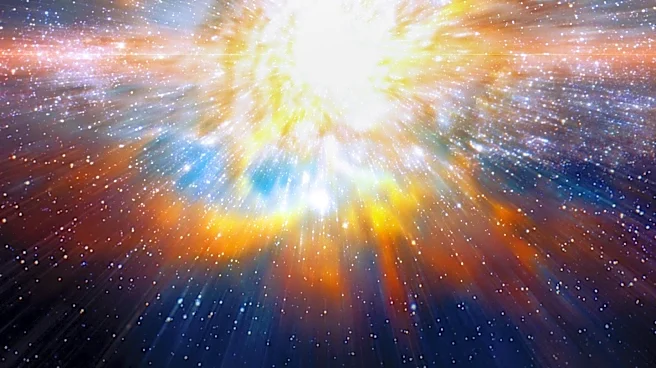
Scientists have published research suggesting that some of the universe's most powerful explosions, previously attributed to hypernovas, may actually be explained by ordinary supernovas. Hypernovas were initially proposed to account for unusual stars
found in the Milky Way's halo and a neighboring dwarf galaxy, as these stars were thought to require debris from an explosion ten times more powerful than an average supernova. However, the new findings indicate that when the uneven, non-spherical way supernovas eject matter is considered, ordinary supernovas can produce the chemical signatures observed in these stars. Anmol Aggarwal of University College London (UCL), a team leader, stated that their mathematical models, which account for the asymmetrical spread of materials like oxygen and sulfur, show that stars with unusual elemental mixes are most likely formed from ordinary supernovas. This re-evaluation suggests that the evidence for hypernovas may no longer be necessary.
Why It's Important?
This discovery significantly impacts our understanding of stellar evolution and the chemical enrichment of galaxies. If ordinary supernovas are capable of producing the conditions previously attributed to hypernovas, it simplifies the cosmic processes involved in the creation of new stars and the distribution of heavy elements. This shift in understanding could lead to revisions in astrophysical models that describe how elements are forged and dispersed throughout the universe. It also highlights the importance of considering the three-dimensional, asymmetrical nature of stellar explosions, rather than assuming uniform distribution of ejected material. The research challenges long-held assumptions and opens new avenues for studying the origins of stars and the chemical composition of galaxies, influencing future astronomical observations and theoretical frameworks.
What's Next?
The team's research, published in the journal Monthly Notices of the Royal Astronomical Society, will likely prompt further investigation and re-analysis of other stars with unusual chemical compositions. Astronomers will need to incorporate the concept of asymmetrical supernova explosions into their models of chemical evolution in galaxies and the interstellar medium. Future observational studies may focus on detecting and characterizing the uneven distribution of elements in supernova remnants to validate these findings. The scientific community will continue to debate and refine the understanding of stellar death and its impact on the universe, potentially leading to a more accurate and nuanced picture of cosmic events.
Beyond the Headlines
The re-evaluation of hypernovas underscores a broader theme in scientific discovery: the continuous refinement of theories as new data and analytical methods emerge. What once seemed to require an extraordinary explanation can sometimes be accounted for by a more common phenomenon, viewed through a more detailed lens. This particular finding also touches upon the intricate 'family histories' of stars, where their chemical signatures act as cosmic fingerprints, revealing the nature of the explosions that birthed them. The idea that a combination of a neutron star merger and an ordinary supernova could create a star with an overabundance of heavy elements, previously thought to require a hypernova, illustrates the complex interplay of cosmic events that shape the universe. This ongoing process of questioning and refining established theories is fundamental to scientific progress.