



What's Happening?
Canadian researchers, including physicists Rajendra Gupta and Nikolaos Samaras from the University of Ottawa, have developed an alternative cosmological model called CCC+TL, which challenges the standard model's reliance on dark matter and dark energy.
This new model combines the Covarying Coupling Constants and 'Tired Light' hypotheses, suggesting that fundamental physical constants can change over time and photons lose energy as they travel through space. According to this theory, phenomena typically attributed to dark matter and dark energy could be explained by these changing constants, eliminating the need for additional invisible components. The CCC+TL model estimates the age of the universe at 26.7 billion years, nearly double the standard model's estimate of 13.8 billion years. The researchers have tested their model against various astronomical observations, including primary nucleosynthesis, cosmic chronometers, and galaxy rotation curves, with some promising initial results.
Why It's Important?
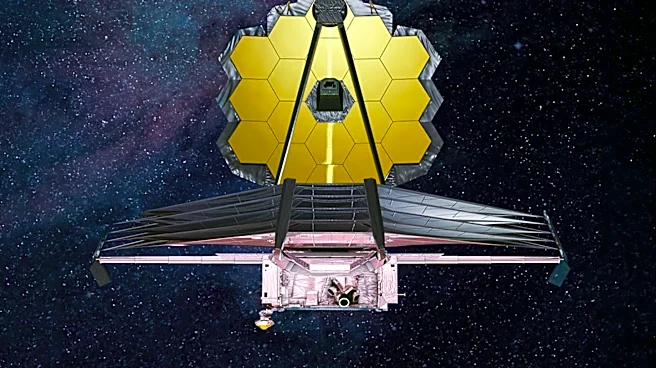
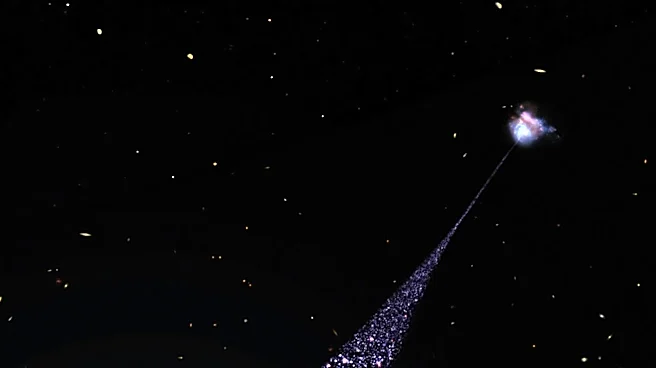
This alternative cosmological model presents a significant challenge to the established understanding of the universe, particularly regarding the roles of dark matter and dark energy. If validated, it could fundamentally alter our perception of cosmic history, the age of the universe, and the forces governing its evolution. The standard Lambda-CDM model, which incorporates dark matter and dark energy, has been highly successful in explaining many observations, but it also faces challenges, such as the existence of unexpectedly massive and developed early galaxies observed by the James Webb Telescope. The CCC+TL model offers a potential explanation for these early galaxies by providing a much longer timeframe for their formation. This research highlights the ongoing scientific inquiry and the pursuit of more comprehensive models to explain the universe's complexities, potentially leading to a paradigm shift in cosmology.
What's Next?
The CCC+TL model requires further rigorous testing and verification against a broader range of astronomical observations. While initial tests have shown some consistency with observed phenomena, the researchers themselves acknowledge that these results are preliminary and need more study. Future observations of very distant galaxies, particularly those by the James Webb Space Telescope's GLIMPSE program, will be crucial in testing the model's predictions. The model's ability to explain the existence of early, massive galaxies will be a key area of focus. The scientific community will need to assess whether this alternative theory can consistently reproduce the entire array of available cosmological data as successfully as the standard Lambda-CDM model, which currently describes many observations from the cosmic microwave background to large-scale structures.
Beyond the Headlines
The debate over dark matter and dark energy extends beyond mere scientific curiosity; it touches upon the very foundations of our understanding of reality. If the CCC+TL model gains wider acceptance, it could lead to a re-evaluation of fundamental physical laws and constants, potentially impacting fields beyond cosmology. The concept of changing physical constants, for instance, could have implications for particle physics and quantum mechanics. This ongoing scientific exploration underscores the dynamic nature of scientific knowledge, where established theories are continually challenged and refined by new observations and alternative hypotheses. The pursuit of a more complete and accurate cosmological model is a testament to humanity's enduring quest to comprehend its place in the universe.