
What's Happening?
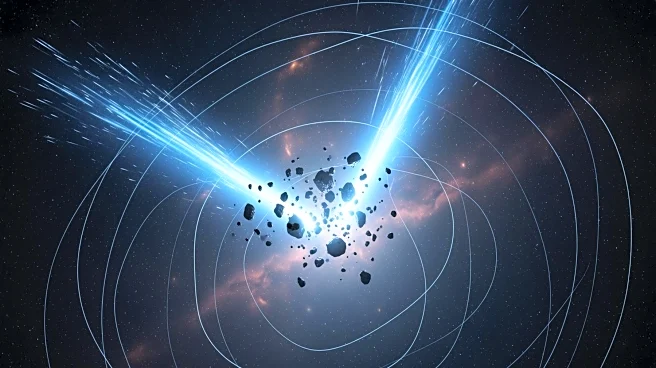
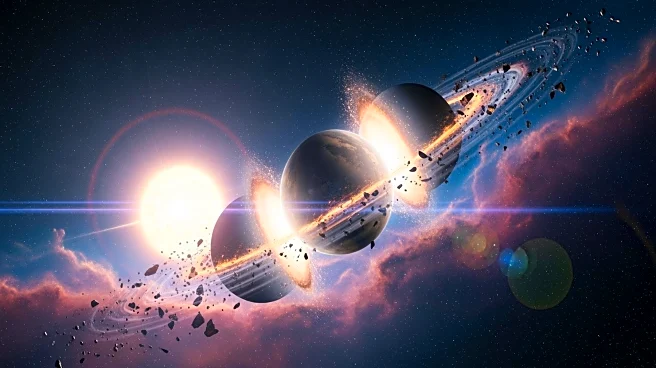
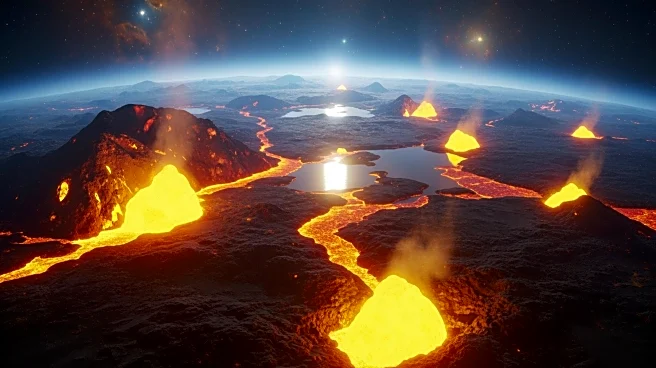
Astronomers have observed what appears to be a collision between two planets orbiting the star Gaia20ehk, located 11,000 light-years from Earth. The event was detected through unusual flickering in the star's light, attributed to debris from the collision passing
in front of the star. This rare observation provides insights into the chaotic environments of young star systems, where planets and protoplanets frequently collide. The collision is reminiscent of the event believed to have formed Earth's Moon, offering a unique opportunity to study planetary formation processes.
Why It's Important?
This discovery is significant for understanding the formation of planetary systems and the conditions that lead to the development of habitable worlds. The collision around Gaia20ehk mirrors the hypothesized impact that created the Earth-Moon system, which plays a crucial role in Earth's habitability. By studying such events, scientists can gain insights into the frequency and nature of planetary collisions, which may influence the development of life-supporting environments. This research could also inform models of planetary system evolution and the potential for life elsewhere in the universe.
What's Next?
Further observations of Gaia20ehk and similar systems could provide more data on the aftermath of planetary collisions. Astronomers may use infrared telescopes to monitor the cooling and solidification of debris, potentially leading to the formation of new planetary bodies. This research could also inspire new theoretical models of planetary system dynamics, helping to predict the likelihood of similar events in other star systems. As more data is collected, scientists hope to better understand the role of such collisions in shaping habitable environments.