






What's Happening?
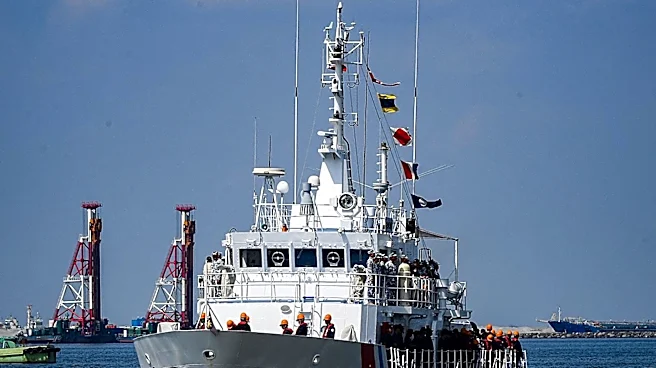
Australia, the Philippines, and the United States recently conducted a Maritime Cooperative Activity (MCA) in the South China Sea, specifically within the Philippines’ Exclusive Economic Zone, from August 19 to 25. This joint exercise involved naval and air
assets from all three nations, including the Royal Australian Navy’s HMAS Supply, a Royal Australian Air Force P-8A Poseidon, the Philippine Navy frigate BRP Diego Silang, Philippine Air Force FA-50PH and A-29B aircraft, the Philippine Coast Guard ship BRP Teresa Magbanua, and the United States Navy’s USS Santa Barbara and a USN P-8A Poseidon. The activity is seen as a countermeasure to China's recent drills and its claims over disputed waters, including near Huangyan Dao. Australia reiterated its stance that the 2016 South China Sea Arbitral Tribunal Award, which China rejects, is final and legally binding.
Why It's Important?
This joint maritime activity underscores the increasing geopolitical tensions and strategic competition in the South China Sea, a critical waterway for global trade and security. The participation of the U.S. alongside regional allies like Australia and the Philippines signals a concerted effort to uphold international law and freedom of navigation in the face of China's expansive territorial claims and military buildup. For the U.S., it reinforces its commitment to its Indo-Pacific strategy and alliances, aiming to deter actions that could destabilize the region. For the Philippines, it strengthens its position in defending its sovereign rights against Chinese assertiveness. The exercise also highlights the importance of multilateral cooperation in maintaining regional security and stability, impacting international shipping lanes and the economic interests of numerous nations.
What's Next?
The continuation of such joint maritime activities is likely, as nations seek to reinforce their presence and commitment to international norms in the South China Sea. China is expected to continue its own drills and assert its claims, potentially leading to further confrontations or diplomatic exchanges. The U.S. and its allies will likely explore additional avenues for cooperation, including intelligence sharing and joint patrols, to enhance interoperability and collective defense capabilities. The diplomatic front will remain active, with ongoing discussions at international forums regarding the legal status of the disputed territories and the enforcement of international arbitration rulings. The long-term trajectory will depend on the willingness of all parties to engage in de-escalation and adherence to international law.
Beyond the Headlines
Beyond the immediate military and diplomatic implications, these activities reflect a broader struggle over the future of the international rules-based order. The South China Sea serves as a microcosm of this global contest, where differing interpretations of sovereignty, maritime law, and regional influence clash. The involvement of the U.S. and Australia signals a commitment to a multilateral approach to security, contrasting with China's more unilateral assertions. This dynamic could lead to a more formalized security architecture in the Indo-Pacific, potentially reshaping alliances and defense strategies. The economic stakes are also immense, as freedom of navigation through these waters is vital for global supply chains, making any disruption a significant concern for international commerce and stability.