






What's Happening?
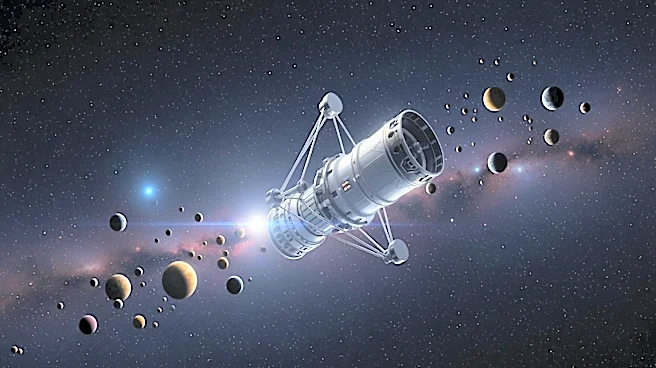
NASA's Chandra X-ray Observatory has detected an X-ray signal that aligns with one of the James Webb Space Telescope's (JWST) discoveries, known as 'little red dots' in the early universe. These dots are now believed to be massive gas clouds concealing
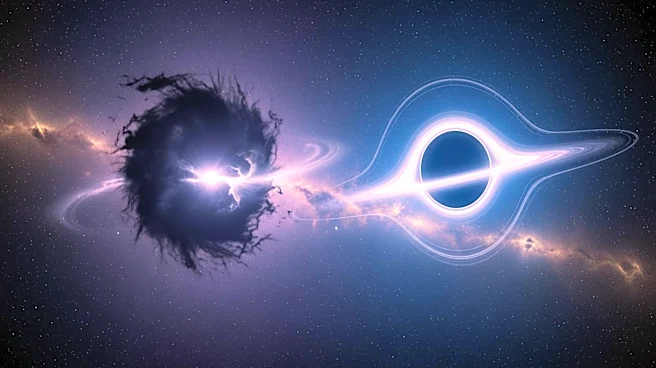
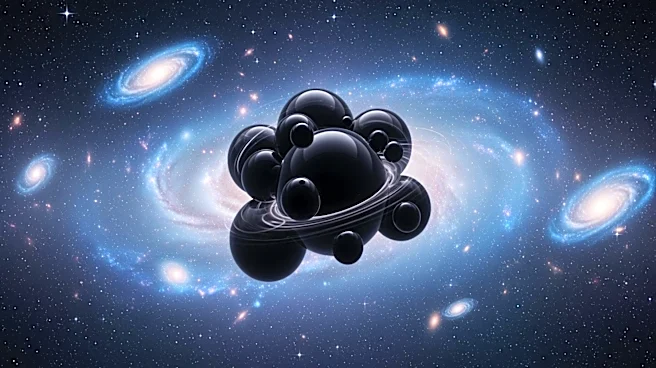
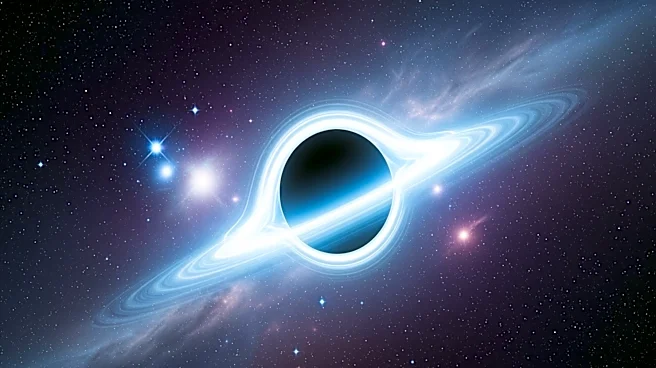
growing supermassive black holes. This finding, reported in Space.com and detailed in The Astrophysical Journal Letters, marks the first time a 'little red dot' has been observed emitting X-rays. The X-ray emissions resemble those from quasars, suggesting these dots are not dim stellar populations but rather dense gas clouds around black holes. The 'black hole star' model suggests these dots are gas clouds, a few hundred light-years across, wrapped around a black hole. The heat from material spiraling into the black hole and jets of charged particles make the cloud glow, resembling a star. This discovery challenges the traditional 'bottom-up' model of black hole formation, which posits that stellar-mass black holes merge over time. Instead, it supports a 'top-down' model where a massive gas cloud collapses directly into a black hole.
Why It's Important?
This discovery is significant for cosmology as it provides a potential explanation for the rapid formation of supermassive black holes in the early universe. The traditional model suggests that black holes grow over time through mergers, but the presence of fully grown supermassive black holes in the early universe contradicts this timeline. The 'black hole star' model offers an alternative, suggesting that these massive structures could form directly from large gas clouds. This finding could reshape our understanding of galaxy formation and the evolution of the universe. It also highlights the importance of combining data from different observatories, as the integration of Chandra's X-ray data with JWST's infrared observations has led to this breakthrough. This underscores the value of maintaining older observatories and designing missions that can collaborate across different wavelengths.
What's Next?
Further research is needed to confirm these findings. This will involve additional X-ray observations, more JWST spectra, and monitoring for variability over time. Such efforts are crucial to solidify the 'black hole star' model and its implications for cosmology. The ongoing collaboration between different space observatories will continue to play a vital role in advancing our understanding of the universe. As more data is collected, scientists hope to refine their models of black hole and galaxy formation, potentially leading to new insights into the early universe.
Beyond the Headlines
The discovery of 'black hole stars' could have broader implications for our understanding of the universe's evolution. It challenges existing cosmological models and may lead to a reevaluation of how galaxies and black holes form and grow. This finding also emphasizes the importance of interdisciplinary collaboration in astronomy, as it was the combination of X-ray and infrared data that led to this breakthrough. The success of this approach could influence future space missions and the development of new technologies for observing the universe.