

What's Happening?
Artificial intelligence (AI) is being increasingly applied to address the challenges posed by climate migration, focusing on equitable solutions for affected communities. AI tools are being used to predict, prevent, and mitigate the consequences of climate migration, drawing
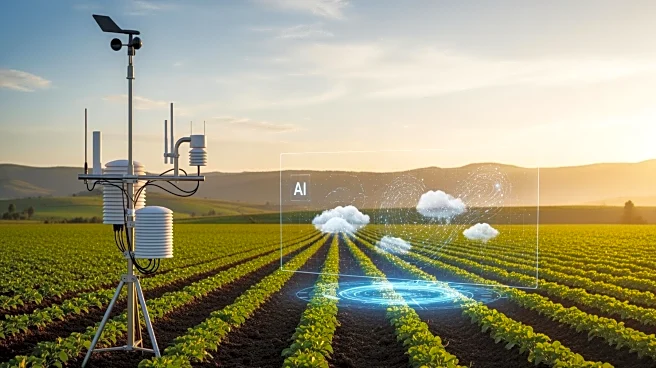
on experiences from healthcare, weather forecasting, and migration management. These tools aim to enhance decision-making capacity, reduce disparities in displacement risks, and mitigate the social, physical, and psychological impacts on climate migrants. AI-driven systems are aiding disaster preparedness by providing early warnings for extreme weather events, although their availability is limited in low-income regions. Collaborations, such as those between the International Organization for Migration and Microsoft, are using AI to anticipate and plan interventions in regions like Ethiopia, where significant populations are at risk of flooding.
Why It's Important?
The application of AI in climate migration is crucial as it offers a pathway to address the inequities faced by vulnerable communities disproportionately affected by climate change. By improving predictive capabilities and disaster response, AI can help mitigate the impacts of climate-induced displacement, potentially reducing the need for migration and strengthening community resilience. However, the reliance on high-quality datasets raises concerns about data accessibility and bias, particularly in underrepresented regions. The integration of AI into disaster preparedness protocols can enhance anticipatory relocation planning and humanitarian logistics, offering a concrete pathway for managing climate migration challenges.
What's Next?
Future developments in AI applications for climate migration will likely focus on expanding the availability of AI-driven systems in low-income and rural areas, addressing data accessibility and bias issues, and enhancing the integration of AI into disaster preparedness protocols. Continued collaboration between organizations and tech companies may lead to more effective interventions and support for displaced populations. Additionally, research into the scalability and sustainability of AI-driven health interventions for migrants and displaced populations is needed to ensure long-term benefits.
Beyond the Headlines
The convergence of AI and emergency response systems presents potential risks, as AI agents could inadvertently exacerbate damage in hazard-impacted communities. Decision-making by AI during emergency responses may unintentionally perpetuate societal inequality, highlighting the need for vigilant oversight. Furthermore, AI-driven smart city interventions risk exacerbating exclusion where migrants lack legal status or digital access, underscoring the importance of safeguards to ensure inclusion rather than surveillance.