







What's Happening?
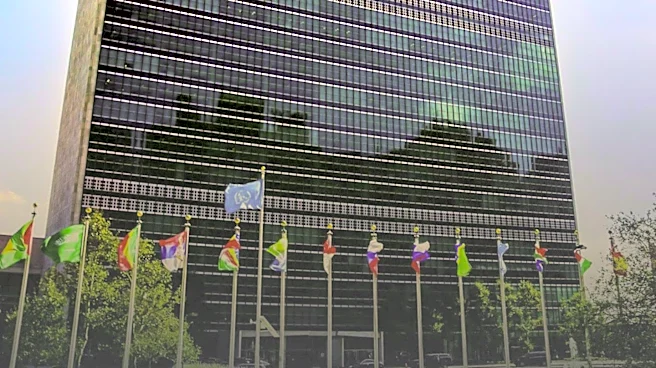
A committee of the United Nations General Assembly has adopted a Japan-led resolution advocating for the abolition of nuclear weapons. This marks the 33rd consecutive year such a resolution has been approved by the assembly. The resolution garnered support
from 150 countries, with seven nations, including China, Russia, Iran, and North Korea, voting against it. Twenty-five countries, notably the United States and France, chose to abstain. The resolution specifically addresses the failure to reach a consensus at the 2026 Review Conference of the Parties to the Treaty on the Non-Proliferation of Nuclear Weapons (NPT), which concluded in May. It urges nuclear-weapon states to fulfill their obligations by engaging in disarmament negotiations. Furthermore, the resolution explicitly states that North Korea cannot be recognized as a nuclear-weapon state and calls for its return to and full compliance with the NPT and International Atomic Energy Agency safeguards.
Why It's Important?
This annual resolution, despite its consistent adoption, highlights the ongoing international division and lack of tangible progress in nuclear disarmament. The abstention of the United States, a nuclear-weapon state, underscores the complex geopolitical landscape surrounding nuclear arms control. While the resolution calls for nuclear-weapon states to fulfill their obligations, the continued possession and modernization of nuclear arsenals by these nations present a significant challenge to the resolution's objectives. The explicit mention of North Korea's status and its non-compliance with international treaties emphasizes the persistent threat of nuclear proliferation and the instability it introduces to global security. The resolution serves as a barometer of international sentiment regarding nuclear weapons, even if it lacks immediate enforcement power, influencing diplomatic discussions and public pressure on nuclear-armed nations.
What's Next?
The resolution is anticipated to be officially adopted at the General Assembly’s plenary meeting in early December. While this adoption is largely symbolic, it will reinforce the international community's call for nuclear disarmament. The upcoming first review conference for the Treaty on the Prohibition of Nuclear Weapons, scheduled for November, will also be a critical event, as the Japan-led resolution only briefly acknowledges its existence. The continued pressure from non-nuclear states, as evidenced by the overwhelming support for this resolution, will likely fuel further diplomatic efforts and discussions within international forums. However, significant breakthroughs in disarmament negotiations will depend on the willingness of nuclear-weapon states, including the United States, to engage more actively and make concrete commitments towards reducing and ultimately eliminating their arsenals.
Beyond the Headlines
The repeated adoption of this resolution, despite the consistent abstentions and 'no' votes from key nuclear powers, reveals a fundamental tension in international relations: the desire for a nuclear-free world versus the perceived security needs of nuclear-armed states. This dynamic creates a persistent ethical and legal dilemma, as the NPT obliges nuclear-weapon states to pursue disarmament, yet progress remains slow. The resolution's focus on North Korea also highlights the broader challenge of non-proliferation and the difficulty of enforcing international norms when states perceive their security to be at risk. The ongoing debate underscores the need for innovative diplomatic approaches and confidence-building measures to bridge the divide between nuclear and non-nuclear states, ultimately aiming for a more secure global environment free from the threat of nuclear weapons.