









What's Happening?
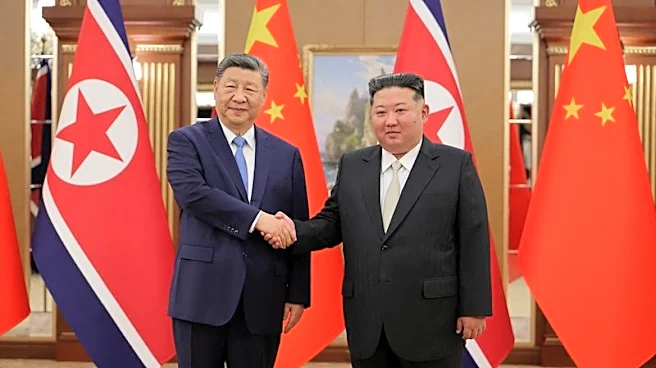
Chinese President Xi Jinping concluded his visit to North Korea, emphasizing the 'ever-renewing friendship' between the two nations. During the visit, Xi and North Korean leader Kim Jong-un agreed to enhance strategic communication and cooperation. Kim expressed
support for the 'One China principle,' which asserts that both sides of the Taiwan Strait belong to one country. The visit highlighted the close ties between China and North Korea, with both leaders attending cultural events and commemorating historical ties. Analysts noted that while the visit underscored solidarity, it also revealed differing priorities, with China focusing on practical state-to-state ties and North Korea emphasizing regime dignity. The visit did not publicly address North Korea's nuclear program or its relations with the United States.
Why It's Important?
The visit underscores China's pivotal role in regional stability and its influence over North Korea. Strengthening ties with North Korea allows China to maintain a strategic ally in the region, which is crucial amid ongoing tensions with the United States and Taiwan. For North Korea, China's support is vital for economic stability and international legitimacy. The visit also signals to the U.S. and its allies that China remains a key player in the Korean Peninsula's geopolitical landscape. The absence of discussions on North Korea's nuclear program suggests that China may prioritize maintaining stable relations over addressing contentious issues, potentially complicating U.S. efforts to denuclearize the Korean Peninsula.
What's Next?
Future developments may include increased economic cooperation and cultural exchanges between China and North Korea. The visit could lead to more frequent high-level meetings and joint initiatives aimed at regional stability. However, the lack of discussion on nuclear issues may prompt the U.S. to seek alternative diplomatic channels to address its concerns. China's continued support for North Korea could also influence its approach to Taiwan, as it seeks to balance regional alliances and assert its geopolitical interests.