
What's Happening?
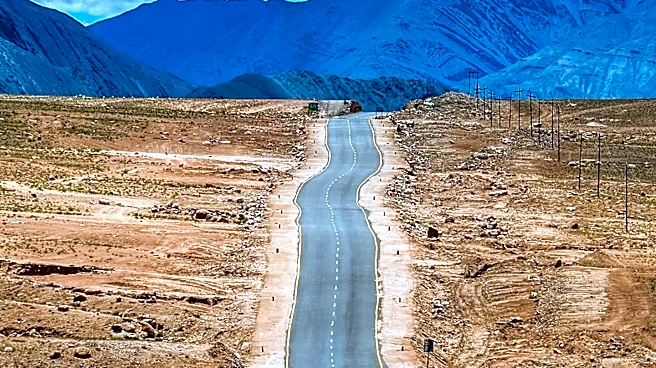
The Taliban-led government in Afghanistan has completed a road through the Wakhan Corridor, reaching the Chinese border at the Wakhjir Pass. This project, funded by Afghan government resources, aims to
create new trade routes and reduce Afghanistan's reliance on Pakistan for commerce. The road, an unpaved track covered with gravel, was completed in phases, with the latest 71-kilometer section contracted in March 2025. Despite the completion, China has not yet agreed to open its border for commercial traffic, citing security concerns. The Wakhjir Pass is closed by snow for at least five months a year, and there is currently no Chinese customs facility on the other side. The project has been a long-standing ambition, with previous attempts stalled due to rugged terrain, security concerns over Uighur fighters, and the change of government in 2021.
Why It's Important?
This development is significant for Afghanistan's economic ambitions, as it seeks to diversify trade outlets and reduce dependence on its traditional routes through Pakistan and Iran, which have faced closures and tensions. The Taliban government hopes the corridor will connect Afghanistan to Chinese and Central Asian markets, potentially integrating it into China's Belt and Road Initiative and generating transit fees. For China, however, the Wakhan Corridor is primarily a security issue, with Beijing prioritizing the protection of its western border, preventing armed groups from entering Xinjiang, and safeguarding its investments. The cautious approach from China highlights the complex geopolitical dynamics in the region, where economic opportunities are often overshadowed by security imperatives. The potential for this corridor to link South, East, and Central Asia could reshape regional trade and influence patterns, but only if security concerns are adequately addressed.
What's Next?
The immediate next step involves China's decision on whether to open its border for commercial traffic through the Wakhjir Pass. This decision hinges on Beijing's assessment of security guarantees provided by the Taliban government, particularly regarding the prevention of Uighur fighters from using the corridor to enter China. The Taliban government will likely continue its diplomatic efforts to persuade China, emphasizing its ability to maintain security. Further development of the corridor, potentially including a railway, depends on Chinese investment and a shift in Beijing's priorities from security to economic integration. Regional and international stakeholders will closely watch these developments, as the corridor's future could significantly impact trade flows and geopolitical alignments in Asia.
Beyond the Headlines
The project underscores the Taliban's quest for international legitimacy and economic stability following their return to power. By pursuing infrastructure projects like the Wakhan road, they aim to demonstrate governance capacity and foster economic ties beyond traditional partners. However, China's reluctance highlights the ongoing international skepticism and security concerns surrounding the Taliban regime. The historical context of the Wakhan Corridor, shaped by 19th-century competition between Britain and Russia, now sees a new layer of geopolitical competition involving China, Afghanistan, Pakistan, and Iran. The corridor's future will be a test case for reconciling economic aspirations with complex security challenges and regional power dynamics, potentially transforming an isolated mountain region into a crucial trade artery or leaving it as a symbol of unfulfilled potential.