
What's Happening?
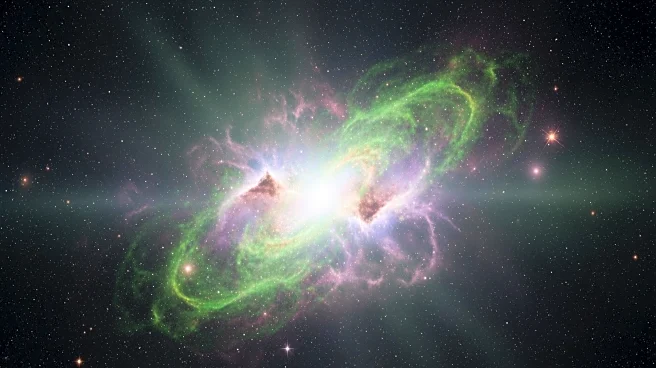
NASA's X-ray Imaging and Spectroscopy Mission (XRISM) has achieved a significant milestone by detecting chlorine and potassium in the Cassiopeia A (Cas A) supernova remnant. This discovery marks the first
time these elements have been identified in the wreckage of a supernova through X-ray detection. The findings were published in Nature Astronomy on December 4, 2025. The composite image of Cas A combines data from NASA's Chandra X-ray Observatory, Hubble, Webb, and Spitzer space telescopes, showcasing the remnant in X-ray, visible, and infrared light. This breakthrough provides new insights into the chemical composition and processes occurring in supernova remnants, contributing to a deeper understanding of the universe's evolution.
Why It's Important?
The detection of chlorine and potassium in the Cas A supernova remnant is a pivotal advancement in astrophysics, offering new perspectives on the chemical elements produced in supernova explosions. These findings enhance our understanding of the life cycle of stars and the distribution of elements in the universe, which are crucial for the formation of planets and life. The ability to identify such elements through X-ray detection opens new avenues for studying other supernova remnants and their contributions to cosmic chemistry. This research not only enriches scientific knowledge but also underscores the importance of space missions like XRISM in unraveling the mysteries of the cosmos.