



What's Happening?
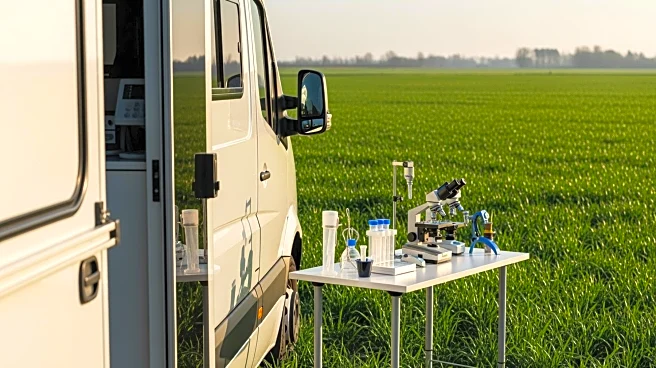
The Punjab government, under the direction of Chief Minister Maryam Nawaz Sharif, has initiated a new program called 'Agriculture Lab on Wheels'. This initiative aims to provide agricultural services directly to farmers at their doorsteps. The program will
establish mobile agriculture laboratories in 15 districts of Punjab, allowing farmers to receive immediate soil and water analysis reports. This service is designed to help farmers accurately assess soil fertility and water quality, thereby improving crop planning and productivity. A central control room will oversee the operations of these mobile labs to ensure efficiency and transparency. Additionally, 100 container-based farmer facilitation centers will be set up across all districts, equipped with data call centers, agriculture officers, and digital tools to provide timely guidance and technical support to farmers.
Why It's Important?
This initiative is significant as it directly addresses the needs of farmers by providing them with essential agricultural information and services at their doorsteps. By enabling farmers to make informed decisions based on accurate soil and water data, the program is expected to enhance crop yields and productivity. The initiative reflects the government's commitment to strengthening the agricultural sector, which is a crucial part of the economy. The introduction of mobile labs and facilitation centers is likely to improve the efficiency of agricultural practices, potentially leading to a record wheat yield in the current season. This could have a positive impact on food security and the overall economic stability of the region.
What's Next?
The success of the 'Agriculture Lab on Wheels' program could lead to its expansion beyond the initial 15 districts, potentially covering more areas in Punjab. The government may also consider integrating additional technological advancements to further enhance the services provided to farmers. Stakeholders, including agricultural experts and policymakers, will likely monitor the program's outcomes to assess its effectiveness and explore opportunities for scaling up. The initiative could also inspire similar programs in other regions, promoting a broader adoption of technology-driven agricultural solutions.