






What's Happening?
A new review by an international team of polar scientists, published within the Horizon Europe project POMP, highlights that polar oceans, including the Arctic and Antarctic, are largely unrecognized in global blue-carbon approaches for climate change
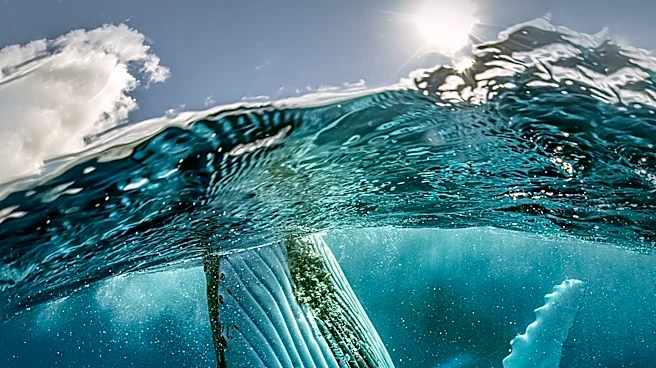
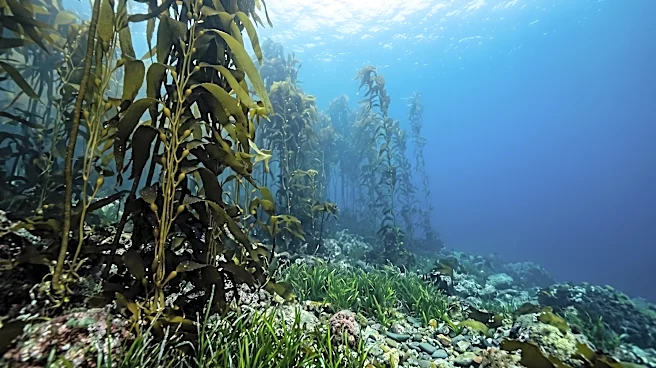
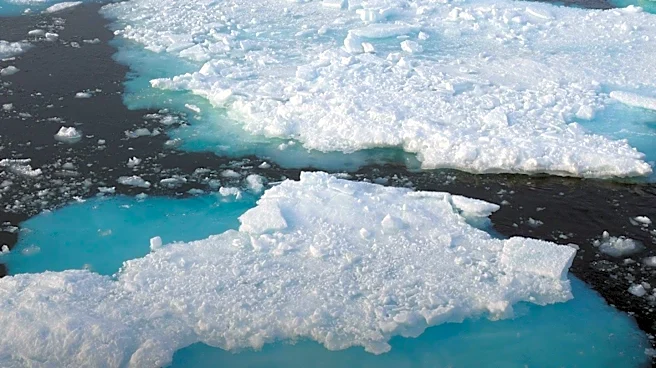
mitigation. These regions, which constitute about 20% of the global ocean, are experiencing rapid environmental changes, with parts of the Arctic warming at up to four times the global average. While traditional blue-carbon strategies focus on tropical and temperate coastal ecosystems like mangroves and salt marshes, polar ecosystems also play a significant role in capturing and storing carbon. The review categorizes polar blue-carbon habitats, noting strong evidence for carbon storage in Arctic salt marshes and seagrass meadows. Other pathways, such as kelp, phytoplankton, and carbon stored in deep-sea sediments, are less understood but are expanding or contributing to carbon sequestration. The study emphasizes that current scientific and policy frameworks are not adequately prepared to integrate the carbon-storage potential of these vital polar systems.
Why It's Important?
The underestimation of polar blue carbon has significant implications for global climate change mitigation efforts. As the Arctic and Antarctic warm at accelerated rates, the carbon dynamics within these ecosystems are changing, potentially impacting the planet's overall carbon budget. Recognizing and integrating polar blue carbon into policy frameworks could unlock new avenues for carbon sequestration and climate action. Without standardized terminology, measurement methods, and coordinated governance, the full potential of these carbon sinks remains untapped. This oversight means that current climate models and mitigation strategies may be incomplete, potentially leading to less effective global responses to climate change. The U.S., as an Arctic nation, has a vested interest in understanding and leveraging these natural processes for environmental and economic stability, as changes in polar regions can have far-reaching effects on global weather patterns and sea levels.
What's Next?
The review calls for four coordinated actions to address the current shortcomings. Firstly, there is a need for greater investment in polar blue-carbon research to improve understanding of these complex ecosystems and their carbon-storage capacities. Secondly, the authors advocate for the precautionary protection of known carbon-rich and vulnerable habitats in polar regions. Thirdly, management approaches should consider carbon storage alongside biodiversity conservation. Finally, clearer pathways are required for recognizing substantial natural carbon stores within policy frameworks. While polar blue carbon is not yet ready to be treated as a conventional carbon-offset mechanism due to uncertainties in measurement and permanence, the immediate focus should be on protecting existing carbon-rich ecosystems and strengthening the scientific and policy foundations for their future recognition. This will involve international collaboration and potentially new policy instruments to address fragmented governance across national jurisdictions in the Arctic and Antarctic.
Beyond the Headlines
The challenges in integrating polar blue carbon into climate policy extend beyond scientific and governance issues, touching upon ethical and cultural dimensions. The rapid changes in polar regions disproportionately affect indigenous communities whose livelihoods and cultural practices are deeply intertwined with these ecosystems. A more comprehensive understanding and protection of polar blue carbon could also contribute to the resilience of these communities. Furthermore, the fragmented governance in the Arctic, spanning multiple national jurisdictions, highlights the broader geopolitical complexities of climate action. The call for a precautionary approach underscores a shift towards proactive conservation, recognizing the intrinsic value of these ecosystems not just as carbon sinks but as critical components of global biodiversity. This also raises questions about equitable resource allocation for research and conservation efforts in these remote and challenging environments.