

What's Happening?
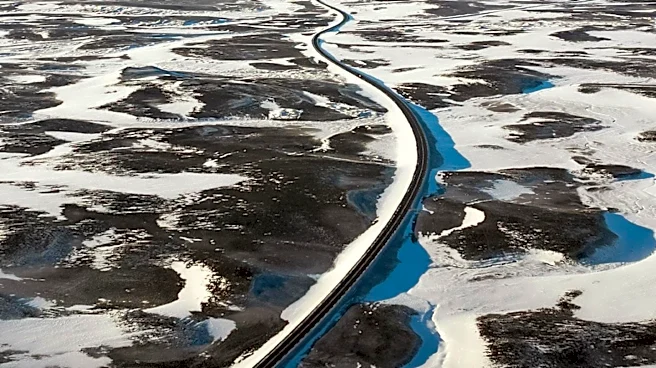
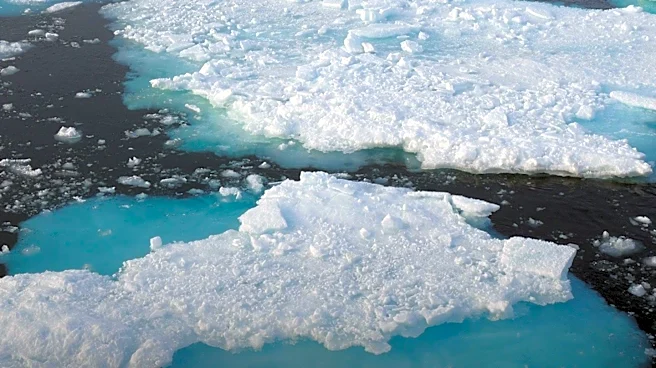
The Arctic, once a crucial carbon sink, is now releasing significant amounts of heat-trapping gases due to rapidly thawing permafrost. This phenomenon is occurring as the Arctic warms four times faster than the global average, causing ground that has
been frozen for millennia to melt. This melting allows long-sequestered organic matter, such as dead plants and animals, to decompose and release methane and carbon dioxide into the atmosphere. Ecologist Ted Schuur of Northern Arizona University describes this as a critical tipping point in climate change, noting that the release of these gases is not expected to cease. The amount of carbon still frozen in permafrost is three times greater than what is currently in the atmosphere, indicating a substantial potential for further emissions. This shift means the Arctic is now contributing to climate change rather than mitigating it, altering the delicate balance of the Earth's carbon cycle.
Why It's Important?
The transformation of the Arctic from a carbon sink to a carbon source has profound implications for global climate change efforts and future warming projections. The release of methane and carbon dioxide from thawing permafrost adds to existing greenhouse gas concentrations, primarily from human activities like burning fossil fuels. This additional warming is often not fully accounted for in current climate models and policy discussions, potentially leading to an underestimation of future temperature increases. Scientists project that these previously trapped gases could contribute an additional 0.25 degrees Celsius of warming by the end of the century, a significant amount comparable to the emissions of a major industrialized nation. Furthermore, the thawing permafrost destabilizes the land itself, leading to ground collapse and sinking, which can have severe consequences for infrastructure and natural landscapes, as evidenced by recent deadly floods linked to glacier collapse in other regions.
What's Next?
The ongoing thawing of Arctic permafrost is expected to continue releasing heat-trapping gases, contributing to further global warming. Scientists anticipate that this process will not stop, and its effects will compound the warming caused by anthropogenic emissions. Future climate models and policy strategies will need to more accurately incorporate these permafrost emissions to provide a comprehensive understanding of future climate scenarios. The destabilization of land due to thawing permafrost will likely lead to increased challenges for communities and industries in Arctic regions, impacting infrastructure such as homes, roads, and pipelines. Researchers are actively monitoring the formation of features like slumps, which are crater-like holes formed by melting ice and collapsing land, to better understand the scale and impact of these changes. The long-term implications suggest a need for new approaches to climate mitigation and adaptation that consider the irreversible nature of this permafrost thaw.
Beyond the Headlines
The awakening of the 'sleeping giant' of permafrost highlights a critical feedback loop in the climate system, where warming causes further warming, making the challenge of climate change even more complex. The sheer volume of carbon stored in permafrost, accumulated over thousands of years, represents a vast reservoir of potential greenhouse gases. The current situation underscores the urgency of reducing global emissions to prevent further acceleration of permafrost thaw. Ethically, this development raises questions about intergenerational equity, as future generations will bear the brunt of these additional emissions. Culturally, the rapid changes in the Arctic challenge traditional understandings of stable environments and necessitate a re-evaluation of human interaction with natural systems. The visible and palpable evidence of thawing permafrost, such as the sewage-like odor in research tunnels from decomposing organic matter, serves as a stark reminder of the immediate and tangible consequences of a warming planet.