
What's Happening?
The sun has erupted with three powerful solar flares in less than 24 hours, potentially sending multiple coronal mass ejections (CMEs) toward Earth. These eruptions, originating from sunspot region 4455,
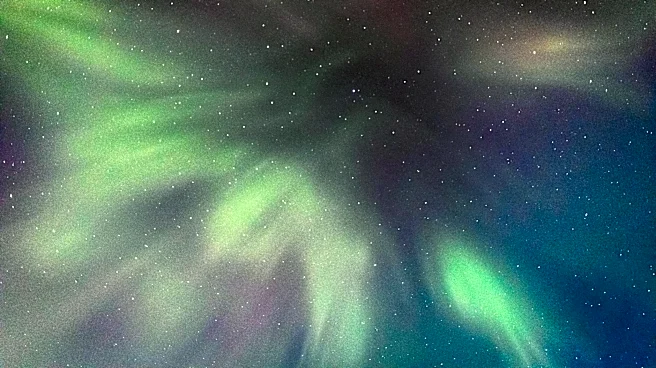
have triggered radio blackouts and increased the chances of northern lights displays. The U.K. Met Office has confirmed that at least one CME is Earth-directed, with a strong geomagnetic storm watch issued for June 4-6. This could lead to visible auroras at lower latitudes than usual.
Why It's Important?
The solar flares and resulting CMEs have significant implications for both scientific observation and public interest. Increased aurora activity provides opportunities for skywatchers and researchers to study geomagnetic storms and their effects on Earth's atmosphere. However, these solar events can also disrupt communication systems and power grids, posing challenges for infrastructure and technology-dependent sectors. Understanding and predicting solar activity is crucial for mitigating potential impacts on global communication and navigation systems.
What's Next?
As scientists continue to analyze the CMEs' trajectories, further solar activity from sunspot region 4455 is possible. The geomagnetic storm watch will remain in effect, with potential for auroras to be visible in more southern regions. Researchers will monitor the situation closely to provide updates and warnings as needed. This event may also prompt discussions on improving space weather forecasting and preparedness to protect critical infrastructure from solar-induced disruptions.