



What's Happening?
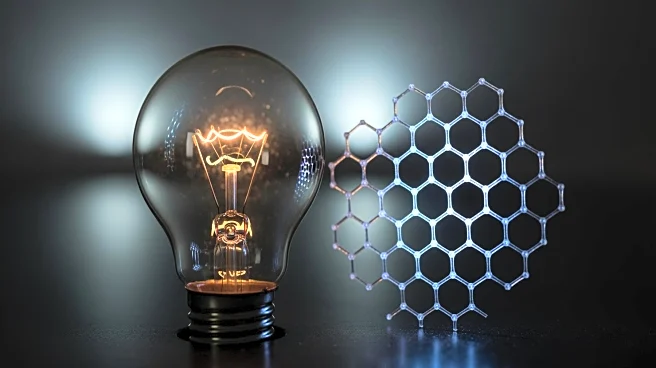
Recent research from Rice University suggests that Thomas Edison's 1879 light bulb experiments may have unintentionally produced graphene. Graphene, a single-atom-thick layer of carbon known for its strength and conductivity, was isolated and characterized
much later, earning a Nobel Prize in 2010. The study, published in ACS Nano, indicates that the carbon-based filaments used in Edison's bulbs, when heated to high temperatures, could have formed graphene. This process, known as flash Joule heating, involves applying a voltage across a resistant material, rapidly heating it to 2,000-3,000 degrees Celsius. Edison's bulbs, which used carbon filaments like Japanese bamboo, reached these temperatures, potentially creating graphene without his knowledge.
Why It's Important?
This discovery highlights the potential for historical experiments to yield modern scientific insights. Graphene is a material with numerous applications in technology and industry, including semiconductors and advanced materials. Understanding its accidental production in Edison's experiments underscores the importance of revisiting historical scientific work with contemporary techniques. This research not only sheds light on Edison's contributions to science but also inspires curiosity about other potential discoveries hidden in past experiments. The findings could lead to new methods for producing graphene and other advanced materials, impacting various sectors of the economy.
Beyond the Headlines
The study raises questions about the untapped potential of historical scientific experiments. It suggests that many past experiments, when re-evaluated with modern technology, could reveal new materials or processes that were previously overlooked. This approach could lead to breakthroughs in materials science and other fields, encouraging scientists to explore the historical context of their work. Additionally, the research highlights the role of serendipity in scientific discovery, where unintended outcomes can lead to significant advancements. This perspective may influence how future experiments are designed and interpreted, fostering a culture of innovation and exploration.