






What's Happening?
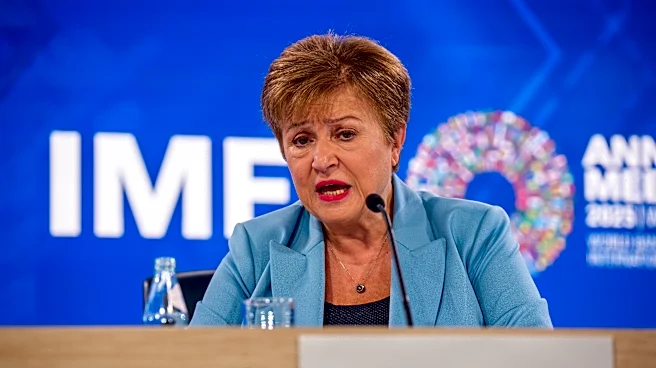
The International Monetary Fund (IMF) announced significant progress in discussions with Ukrainian authorities towards a staff-level agreement that would release $1.6 billion in funds for Kyiv. This disbursement is contingent upon securing necessary financing
assurances. Virtual discussions are ongoing, with the aim of reaching this agreement in the near term. IMF staff and Ukraine are also engaging with international partners to secure these assurances, given the prolonged nature of the conflict. Cooperation with the IMF is crucial for Ukraine to ensure funding from other partners and maintain economic stability, as the country faces a multi-billion dollar financing shortfall for the upcoming year. The IMF estimates Ukraine's residual financing gap to be between $32 billion and $34 billion in 2027 and $17 billion in 2028. A review combining the second and third assessments of Ukraine's four-year $8.1 billion Extended Fund Facility program began on November 9. The IMF noted improved performance under the program since the first review, emphasizing the need to sustain reform momentum to unlock committed financing and mobilize additional revenues and donor support.
Why It's Important?
This potential $1.6 billion disbursement from the IMF is critical for Ukraine, which is grappling with severe economic challenges exacerbated by the ongoing conflict. The country's economic outlook has been sharply revised downwards, with a projected GDP contraction of 0.5% in 2026 and 1% in 2027, primarily due to the challenging security situation and increased attacks on economic infrastructure. The IMF's support is not just about the direct funds; it also acts as a catalyst, unlocking further financial assistance from other international partners. Without this aid, Ukraine faces a substantial financing gap, which could destabilize its economy and hinder its ability to sustain essential services and defense efforts. The emphasis on 'financing assurances' highlights the international community's cautious approach, seeking guarantees that funds will be effectively utilized and that Ukraine's financial stability can be maintained in the long term. This situation underscores the profound economic impact of prolonged conflict and the vital role of international financial institutions in supporting war-torn economies.
What's Next?
Virtual discussions between the IMF and Ukrainian authorities are continuing with the immediate goal of reaching a staff-level agreement for the $1.6 billion disbursement. Ukraine must sustain its reform momentum, as noted by IMF mission chief Gavin Gray, to unlock committed financing and secure additional donor support. While Ukraine met all quantitative performance criteria by the end of September and improved structural reform momentum, it still needs to complete progress on two structural benchmarks related to the energy regulator's independence and amendments to the tax code. The IMF and Ukraine will continue to engage with international partners to secure the necessary financing assurances, which are crucial given the projected continuation of the war through 2027. The successful conclusion of this agreement will likely pave the way for further international financial assistance, while failure could exacerbate Ukraine's economic vulnerabilities.
Beyond the Headlines
The IMF's ongoing engagement with Ukraine reflects a broader strategy of supporting countries in conflict zones to prevent economic collapse, which could have wider geopolitical ramifications. The significant financing gap projected for Ukraine in the coming years underscores the immense and sustained international effort required to keep the country economically viable amidst a prolonged war. This situation also highlights the delicate balance between providing emergency financial aid and ensuring accountability and reform in a wartime environment. The IMF's focus on structural reforms, even during conflict, suggests an attempt to lay the groundwork for post-war recovery and long-term economic stability. However, the practical implementation of these reforms can be challenging under constant security threats. The need for 'financing assurances' from international partners also points to a collective burden-sharing approach, where the financial stability of Ukraine is seen as a shared responsibility, reflecting the interconnectedness of global economies and security.