
What's Happening?
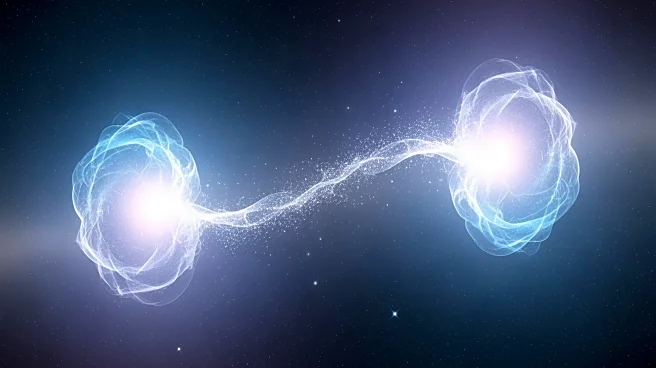
Astronomers using the Atacama Large Millimeter/submillimeter Array (ALMA) have observed a rare 'ghost bridge' of gas and dust connecting two infant stars, L1448 IRS3A and L1448 IRS3B, located approximately
1,000 light-years away in the Perseus molecular cloud. This bridge, about 1,800 astronomical units long, likely formed due to gravitational interactions between the stars, stripping material from their planet-forming disks. The discovery, led by Youngwoo Choi from Seoul National University, provides a unique glimpse into the dynamics of young star systems and their formation processes.
Why It's Important?
The observation of the 'ghost bridge' offers significant insights into the early stages of star formation and the interactions within stellar nurseries. Such phenomena are crucial for understanding how stars and their planetary systems evolve. The findings could impact theories on star formation and the development of planetary systems, potentially influencing future astronomical research and models. This discovery also highlights the capabilities of ALMA in capturing detailed cosmic events, contributing to the broader field of astrophysics.
What's Next?
Further studies are expected to explore the dynamics of the 'ghost bridge' and the interactions between L1448 IRS3A and L1448 IRS3B. Researchers may conduct additional observations and simulations to better understand the gravitational effects and material exchange between the stars. These efforts could lead to new insights into the formation and evolution of multiple-star systems, enhancing our understanding of the universe's complex processes.