




What's Happening?
North Korea is actively integrating artificial intelligence (AI) into its missile guidance systems and other military technologies, according to recent reports. Leader Kim Jong Un has personally overseen tests of AI-enabled attack and reconnaissance drones,
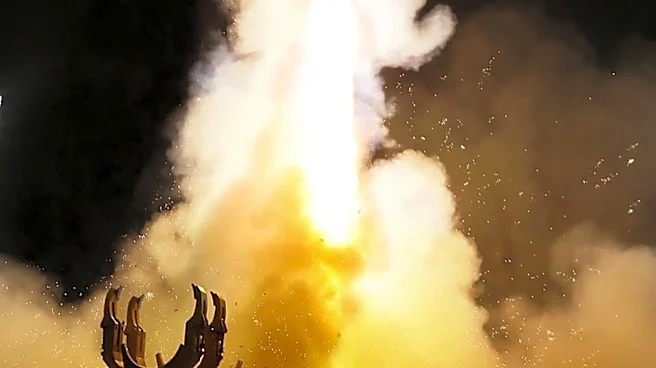
emphasizing the prioritization of unmanned equipment and AI in modernizing the armed forces. North Korean media also reported a test of a tactical cruise missile utilizing AI for target acquisition and terminal guidance. This push for AI integration extends to nuclear-capable systems, with claims that the 600-mm multiple rocket launcher (KN-25) features AI in its guidance. The General Staff Department of the Korean People’s Army established an Electronic Warfare and AI Operation Command in 2024, and orders were issued in August 2025 to integrate AI-based unified management systems for nuclear weapons. These developments highlight North Korea's commitment to leveraging advanced technology despite potential limitations in hardware and infrastructure.
Why It's Important?
The integration of AI into North Korea's military capabilities, particularly its nuclear and missile programs, significantly alters the regional and global security landscape. This advancement could lead to a more aggressive and unpredictable nuclear posture from Pyongyang, as AI-enabled systems might shorten decision-making timelines and increase the risk of accidental escalation. North Korea's existing aggressive nuclear doctrine, which includes provisions for preemptive strikes and delegative command authority for nuclear launches, becomes even more concerning when paired with automated AI systems. The potential for AI to enhance targeting, early warning, and delivery capabilities could erode the mutual vulnerability that underpins stable deterrence, especially for a state like North Korea with a 'use it or lose it' mentality. This development poses a direct challenge to U.S. and allied security interests in the Indo-Pacific, necessitating a reevaluation of missile defense strategies and diplomatic approaches.
What's Next?
The international community, particularly the U.S. and its allies South Korea and Japan, will likely intensify efforts to monitor North Korea's AI and missile development. There may be increased investment in missile defense architecture and other capabilities to address the evolving threat. Policymakers are urged to examine the risks of AI in nuclear command and control and consider voluntary restraints on capabilities that could destabilize nuclear equilibria. Discussions around a 'human in the loop' clause for AI in military systems, similar to the 2024 agreement between the U.S. and China, could become a focus for multilateral arms control efforts. China's role in influencing North Korea's behavior, particularly regarding biological risks and nuclear capabilities, will also be crucial. The ongoing limitations in North Korea's hardware, data, and infrastructure may constrain the full rollout of these AI technologies, but the potential for defects and unintended escalations remains a significant concern.
Beyond the Headlines
The rapid embrace of AI by North Korea's military raises profound ethical and strategic questions. The potential for AI systems to produce false positives, especially in a context lacking diplomatic relations and crisis communication channels, could lead to catastrophic miscalculations. The shift towards automated attack protocols and compressed decision timelines reduces the human element in critical nuclear decisions, increasing the risk of unintentional escalation. Furthermore, North Korea's unique vulnerabilities and aggressive posture make it a particularly dangerous actor in an AI sprint scenario. The development of AI-enabled biological weapons or the exploitation of zero-day vulnerabilities by North Korea's hacking capabilities, as suggested by the $6 billion Binance hack, highlights a broader spectrum of asymmetric threats. This technological arms race underscores the urgent need for international cooperation on AI governance and arms control to prevent a new era of instability.