
What's Happening?
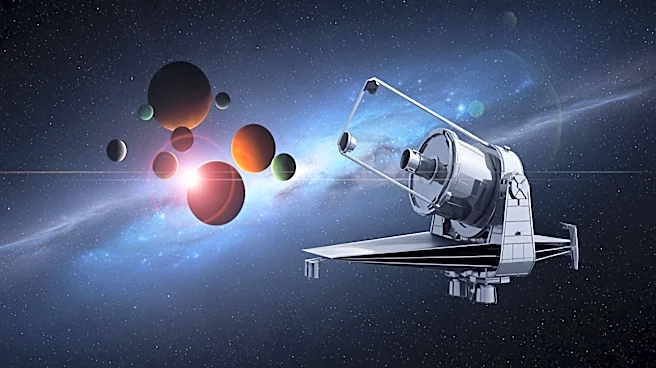
NASA's Transiting Exoplanet Survey Satellite (TESS) has identified a new exoplanetary system, TOI-201, that challenges traditional models of planetary formation. Unlike the typical orderly systems where
planets form in a flattened disk and maintain similar orbits, TOI-201 features three distinct objects with misaligned orbits and strong gravitational interactions. This irregular configuration provides scientists with a unique opportunity to observe the dynamic reshaping of planetary systems. The discovery was made possible through observations from a telescope in Antarctica, which offered the stable conditions necessary to track the system's subtle orbital changes. The findings, published in the journal Science, suggest that the chaotic state of TOI-201 may represent an early stage of planetary evolution, offering insights into the processes that shape planetary systems.
Why It's Important?
The discovery of the TOI-201 system is significant as it challenges existing theories about planetary formation and evolution. By observing a system in the midst of gravitational reshuffling, scientists gain direct evidence of dynamic processes that are usually inferred from theoretical models. This could lead to a reevaluation of how common such chaotic systems might be and how they eventually stabilize. The findings also highlight the importance of long-term monitoring and advanced detection methods in uncovering the complexities of planetary systems. As more systems like TOI-201 are discovered, they will provide valuable data to refine our understanding of planetary dynamics and the formation of stable systems like our own solar system.
What's Next?
Future research will likely focus on monitoring the TOI-201 system to better understand the gravitational interactions at play and their long-term effects on the system's stability. As detection technologies improve, astronomers anticipate discovering more systems with similar chaotic characteristics, which will further inform models of planetary formation. Additionally, the unique observational capabilities provided by the Antarctic telescope may be leveraged to study other distant and complex systems, potentially leading to more groundbreaking discoveries in exoplanetary science.