


What's Happening?
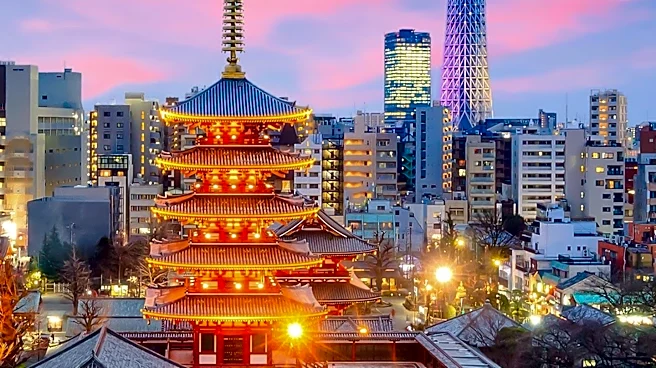
Tokyo, Japan's capital, is characterized by a unique blend of ultramodern architecture and traditional elements, including historic temples and shrines. The city boasts an extensive rail network, which includes the world's busiest railway station. Tokyo is also
recognized for its diverse neighborhoods and rich food culture, hosting more Michelin-starred restaurants than any other city globally. The Greater Tokyo Area is the world's largest metropolitan area by population, with over 37 million residents. Historically, Tokyo, originally known as Edo, became Japan's political center in 1603 under Tokugawa Ieyasu's shogunate. In 1868, Emperor Meiji moved to Edo, renaming it Tokyo, meaning 'Eastern Capital,' and the city rapidly adopted new technologies. Despite significant destruction from the Great Kanto Earthquake in 1923 and wartime bombing in 1945, many historic sites, such as Senso-ji Temple, founded in 628, have been rebuilt, preserving Tokyo's cultural heritage. The city operates on Japan Standard Time (JST, UTC+9) and does not observe Daylight Saving Time.
Why It's Important?
Tokyo's dual identity as a hub of modernity and tradition offers a significant model for urban development and cultural preservation. Its extensive and efficient rail network is crucial for managing the transportation needs of its vast population, providing lessons in urban planning and infrastructure for other global cities. The city's leading position in culinary excellence, with numerous Michelin-starred restaurants, highlights its economic and cultural influence in the global food industry. The historical evolution from Edo to Tokyo demonstrates a continuous adaptation to change while maintaining a strong connection to its past, which is vital for national identity and tourism. The resilience shown in rebuilding after major disasters, such as the 1923 earthquake and World War II bombings, underscores a commitment to cultural heritage and urban regeneration, offering insights into disaster recovery and urban resilience strategies.
What's Next?
Tokyo is expected to continue its trajectory of innovation and cultural preservation. Ongoing urban development projects will likely focus on integrating advanced technologies while maintaining the city's unique historical character. The tourism sector will continue to promote both its modern attractions, like neon-lit skyscrapers, and its traditional sites, such as the Meiji Shinto Shrine and Senso-ji Temple. Efforts to enhance public transportation will likely persist, given the city's status as a major global hub. Furthermore, Tokyo's role as a center for international business and finance will continue to attract global attention, potentially leading to further growth in its capital markets and related surveillance activities. The city's commitment to sustainability and resilience in the face of natural disasters will also remain a key focus for future planning and development.
Beyond the Headlines
Beyond its visible modernity and historical landmarks, Tokyo embodies a profound cultural philosophy where efficiency and respect for tradition coexist. The meticulous rebuilding of historical sites after devastating events reflects a deep-seated value for heritage and continuity, rather than merely replacing the old with the new. This approach influences not only urban planning but also daily life, where ancient customs are seamlessly integrated into a fast-paced, technologically advanced society. The city's emphasis on a highly organized and punctual public transport system, for instance, is not just about efficiency but also reflects a collective societal discipline. The blend of traditional Japanese aesthetics with contemporary luxury, as seen in establishments like The Okura Tokyo, illustrates a sophisticated cultural dialogue that continually redefines what it means to be a global city while staying true to its roots. This cultural synthesis offers a unique perspective on balancing progress with identity in an increasingly globalized world.