






What's Happening?
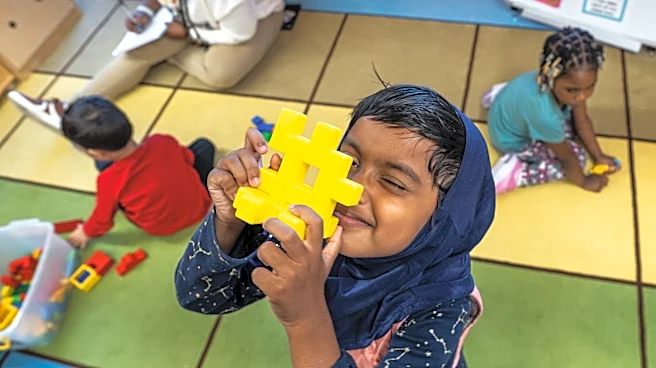
New research from The University of Manchester indicates that children as young as five years old possess a surprising capacity to understand and engage with complex human rights concepts. Dr. Rebecca Simpson-Hargreaves conducted a study involving children aged
five to nine, utilizing the picture book 'Dreams of Freedom,' which is based on the Universal Declaration of Human Rights. The study found that children interpreted ideas about rights through their personal experiences, cultural knowledge, and interactions with peers, challenging the assumption that such topics are too intricate for young minds. When asked to create their own 'rights pages,' children proposed ideas like 'Freedom to protect wildlife,' 'Men and women should have the same rights,' and 'Freedom to love,' demonstrating an understanding rooted in empathy, fairness, and protection. The research also revealed children's ability to critically reflect on adult-child power dynamics.
Why It's Important?
This research is significant because it redefines the perceived cognitive abilities of young children regarding abstract concepts like human rights. It suggests that early childhood education can effectively incorporate these fundamental principles, fostering a generation with a deeper understanding of social justice, equality, and individual dignity. For U.S. educational systems, these findings could encourage the development of more comprehensive and age-appropriate curricula that introduce human rights earlier, potentially leading to more empathetic and socially conscious citizens. By recognizing children's capacity for critical thinking on these issues, educators can create more engaging and empowering learning environments. This understanding can also inform public policy discussions around children's rights and their participation in societal conversations.
What's Next?
The findings from this research could lead to a re-evaluation of how human rights education is approached in early childhood settings. Educators and curriculum developers may explore integrating more picture books and open-ended discussion formats into classrooms to facilitate children's engagement with complex social issues. Further research might investigate the long-term impact of early human rights education on children's social development and civic engagement. The study also suggests a need for more resources that empower children to express their perspectives on rights, potentially leading to the creation of new educational tools and methodologies. Policy discussions around children's agency and their role in understanding societal norms could also be influenced by these insights.
Beyond the Headlines
This study delves into the profound implications of children's innate sense of fairness and justice, suggesting that these are not merely learned behaviors but deeply ingrained cognitive processes that can be nurtured. It challenges the traditional adult-centric view of knowledge dissemination, advocating for approaches that allow children to construct their own understanding of complex ethical frameworks. The ability of young children to critically question adult authority regarding societal norms highlights a potential for early civic engagement and the development of independent thought. This research underscores the ethical imperative to provide children with platforms to voice their perspectives on rights and social issues, recognizing them not just as recipients of information but as active participants in shaping a more just world.