
What's Happening?
The Dana Foundation and The Greenwall Foundation are supporting initiatives aimed at understanding and restoring public trust in science, recognizing that traditional communication methods are insufficient.
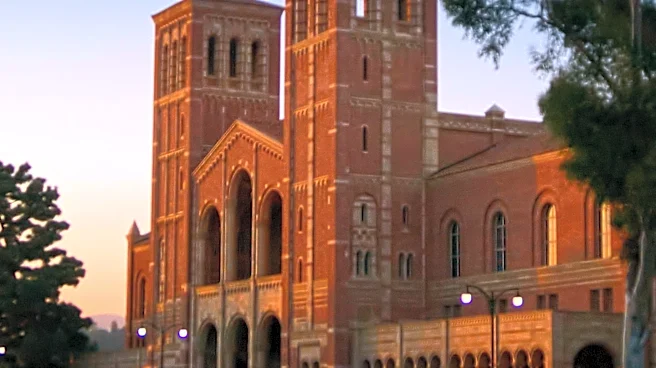
One such initiative involves a partnership between the University of California Los Angeles (UCLA) and Charles R. Drew University of Medicine and Science (CDU). This collaboration focuses on community-partnered research, where scientists engage directly with residents to identify local challenges and explore how neuroscience can address them. An example of this is a project in South Los Angeles, where researchers listened to community concerns about low-flying helicopter noise disrupting children's sleep. In response, scientists conducted studies replicating these noise patterns in animal models, which revealed impaired brain function. These findings were then presented to the city council, influencing a decision to pause helicopter fleet expansion and request further research. This approach emphasizes two-way communication and the integration of community knowledge into scientific inquiry, moving beyond a top-down model of scientific communication.
Why It's Important?
This collaborative model is crucial for rebuilding and sustaining public trust in scientific institutions, particularly in communities that may feel disconnected from or underserved by traditional research. By actively involving community members in identifying research questions and sharing findings, the initiative legitimizes the value of science and medicine in addressing real-world problems. This approach fosters a sense of ownership and relevance among the public, which can counteract skepticism and misinformation. The success in South Los Angeles, where scientific findings directly influenced local policy decisions regarding helicopter noise, demonstrates the tangible impact of such partnerships. This model highlights that trustworthiness is not merely about communicating scientific facts but about building relational infrastructure through ongoing engagement, mutual respect, and a willingness to incorporate diverse perspectives. It underscores the idea that trust in science is a complex issue requiring multifaceted solutions beyond simple messaging.
What's Next?
The UCLA-CDU collaboration is continuing its work with South Los Angeles residents, with a new focus on understanding how music affects brain health and resilience. This ongoing engagement suggests a long-term commitment to community-partnered research. The Dana Foundation and The Greenwall Foundation will also continue to fund research aimed at better understanding trust at various levels, including trust between patients and clinicians, trust in organizations, and public trust in regulators. These efforts indicate a broader movement within the scientific and philanthropic communities to develop more effective strategies for building and maintaining public confidence in science. The emphasis will likely remain on fostering dialogue, integrating diverse knowledge systems, and demonstrating the direct benefits of scientific research to communities.
Beyond the Headlines
The initiative's focus on community-partnered research has deeper implications for the ethical dimensions of science and the role of academic institutions in society. By acknowledging that trust moves in both directions, researchers are challenged to extend trust to community partners and value knowledge from outside traditional research settings. This approach can lead to more relevant and impactful research outcomes, as it addresses issues that are genuinely important to the affected populations. It also highlights the importance of transparency, responsiveness, and integrity in scientific practice, moving beyond mere expertise. The success of such projects could inspire a paradigm shift in how scientific research is conducted and disseminated, fostering a more inclusive and equitable scientific enterprise that is truly accountable to the public it serves. This model could also help bridge divides between scientific communities and the public, promoting a shared understanding of complex issues.