







What's Happening?
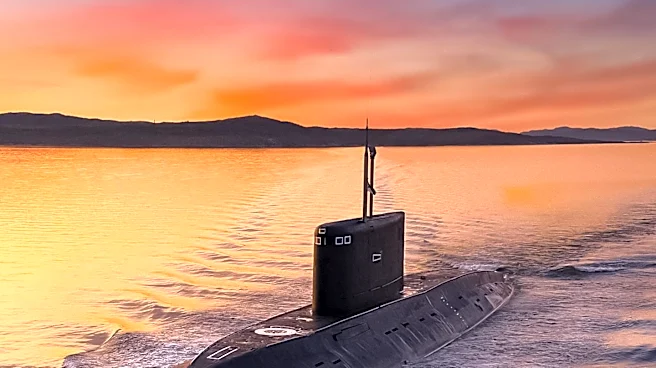
During the Cold War, the Soviet Union developed a unique nuclear-powered cruise-missile submarine, the K-222, also known as the Papa-class or Project 661. This submarine was designed with an extraordinary emphasis on speed, achieving a world record of
approximately 44.7 knots (over 50 miles per hour) underwater during trials in 1970. Its primary mission was to rapidly approach U.S. Navy aircraft carrier groups, launch anti-ship missiles, and then quickly reposition to evade pursuit. The K-222 was distinctive for its titanium hull, which provided an excellent strength-to-weight ratio, improved corrosion resistance, and a reduced magnetic signature compared to steel-hulled submarines. However, the use of titanium made its construction exceptionally complex and expensive, leading to its nickname 'Golden Fish' and the fact that only one unit was ever built.
Why It's Important?
The K-222 represents a significant chapter in Cold War naval strategy and technological innovation, particularly in the context of countering U.S. naval power. Its development underscored the Soviet Union's determination to find asymmetric solutions to the U.S. advantage in aircraft carriers. The submarine's record-breaking speed demonstrated the potential for high-performance undersea warfare, pushing the boundaries of submarine design and propulsion. For the U.S., the existence of such a fast and potent submarine would have necessitated continuous advancements in anti-submarine warfare (ASW) capabilities and tactics. The K-222's design challenges, particularly with titanium construction, also highlight the immense industrial and engineering efforts undertaken during the Cold War arms race, influencing subsequent submarine development in both the U.S. and Russia. It serves as a historical example of how strategic imperatives can drive extreme technological solutions.
What's Next?
While the K-222 itself was a singular project and is no longer operational, its legacy continues to influence modern submarine design and strategic thinking. The pursuit of speed and stealth remains a critical aspect of naval warfare, and the lessons learned from the K-222's titanium construction and powerful propulsion systems have likely informed subsequent generations of nuclear submarines. Modern naval powers, including the U.S., continue to invest heavily in advanced materials, propulsion technologies, and ASW capabilities to maintain a strategic edge. The historical context of the K-222 also serves as a reminder of the continuous innovation required to counter evolving threats in undersea domains. Future developments in submarine technology will likely focus on balancing speed, stealth, and payload capacity, building on the experimental foundations laid by projects like the 'Golden Fish.'
Beyond the Headlines
The K-222's story extends beyond its technical specifications, offering insights into the broader ethical and economic dimensions of the Cold War. The immense cost and effort dedicated to building a single, highly specialized submarine raise questions about resource allocation during a period of intense global competition. Ethically, the development of such a weapon, designed to target aircraft carriers, reflects the constant tension between deterrence and the potential for catastrophic conflict. The 'Golden Fish' also symbolizes the cultural and scientific pride associated with technological breakthroughs, even when driven by military objectives. In the long term, the K-222's existence contributed to the overall strategic stability of the Cold War by creating a mutual deterrence, albeit through a continuous arms race. It underscores how technological advancements in one nation can compel others to innovate, leading to a perpetual cycle of military development and counter-development.