
What's Happening?
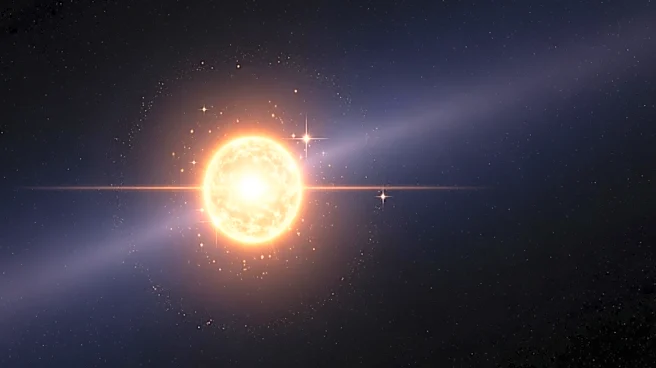
Undergraduate students at the University of Chicago have discovered one of the oldest known stars in the universe, using data from the Sloan Digital Sky Survey (SDSS). The star, identified as SDSSJ0715-7334,
originated in a nearby companion galaxy and later migrated into the Milky Way. This discovery was made during a field course in astrophysics, where students analyzed data and selected 77 stars for further study. The star was found to be extraordinarily pure, consisting almost entirely of hydrogen and helium, indicating its formation early in cosmic history. It is the most metal-poor star ever observed, suggesting it belongs to the earliest generations of stars.
Why It's Important?
The discovery of such an ancient star provides valuable insights into the conditions of the early universe. Understanding the chemical composition and origin of these stars helps astronomers trace the evolution of galaxies and the universe. This finding also demonstrates the power of big data projects like SDSS in enabling significant scientific discoveries. The involvement of undergraduate students in this research highlights the educational value of such projects, inspiring future generations of astronomers and scientists.
What's Next?
The research team plans to continue studying the star's chemical composition and trajectory to gain further insights into its history and the early universe. This discovery may lead to additional studies on other ancient stars, contributing to a deeper understanding of galactic evolution. The success of this project may also encourage more educational institutions to incorporate big data analysis into their curricula, fostering a new wave of scientific exploration and discovery.