




What's Happening?
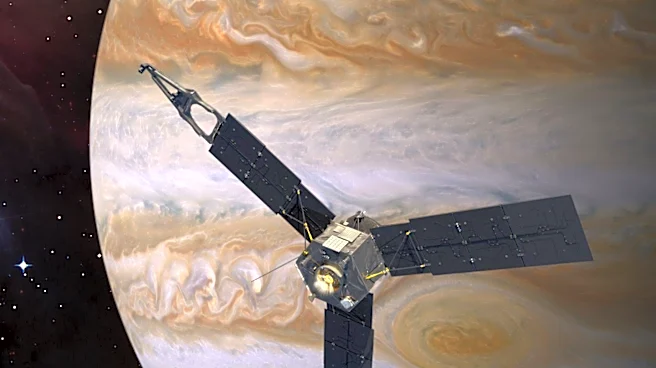
NASA's Voyager 1, launched in 1977, remains the oldest operational spacecraft and the farthest human-made object from Earth. Despite its age, it continues to send data back to Earth, with messages taking 23 hours to reach. Originally tasked with exploring
Jupiter and Saturn, Voyager 1 has exceeded its mission, discovering new rings and moons around these planets. The spacecraft carries a golden record with greetings in 55 languages and sounds of nature, intended for any extraterrestrial life it might encounter. However, the spacecraft faces challenges, such as failing systems and a draining nuclear battery, which threaten its ability to communicate with Earth.
Why It's Important?
Voyager 1's continued operation provides invaluable data about the outer solar system and interstellar space, contributing to our understanding of the cosmos. Its longevity and resilience demonstrate NASA's engineering prowess and the potential for long-term space exploration. The mission also symbolizes humanity's quest for knowledge and connection with the universe, as it carries messages intended for other cosmic travelers. The eventual loss of contact with Voyager 1 will mark the end of an era in space exploration, but its legacy will persist as a testament to human curiosity and ingenuity.
What's Next?
As Voyager 1's systems continue to degrade, NASA engineers are working to extend its operational life as long as possible. The spacecraft's thrusters, crucial for maintaining communication with Earth, are at risk of freezing, and efforts are focused on preserving their functionality. Eventually, Voyager 1 will cease to communicate, but it will continue its journey through space, carrying its golden record as a message from Earth. The mission's data will continue to be analyzed, providing insights into the conditions of interstellar space and informing future space exploration missions.