



What's Happening?
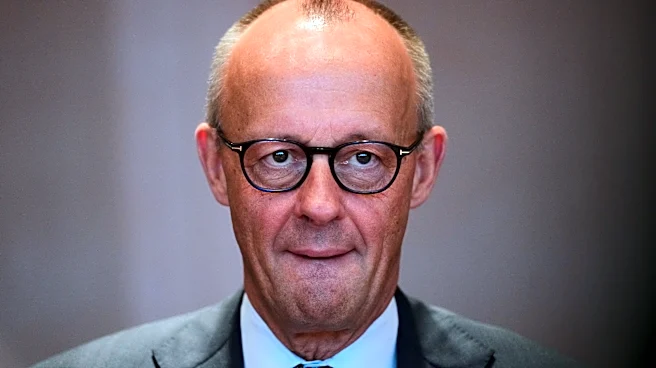
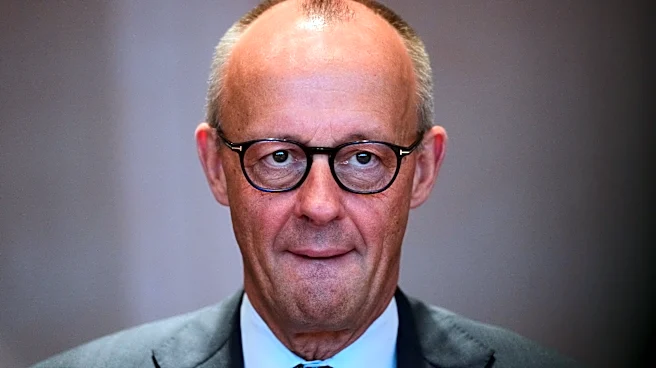
Friedrich Merz, Germany's leader, is maintaining his position despite significant losses for his Christian Democratic Union (CDU) party in recent state elections. The CDU experienced its worst result since World War II in Mecklenburg-Western Pomerania
and Berlin. In Mecklenburg-Western Pomerania, the party received only 4.9% of the vote, falling below the threshold for parliamentary representation. In Berlin, the far-left Die Linke secured the most votes with 25.7%, while the far-right Alternative for Germany (AfD) made considerable gains in both states. Merz acknowledged the results as a 'disaster' for the political center but affirmed his commitment to his federal agenda of tax and welfare reforms, which he describes as an 'antidote to the poison of authoritarianism.'
Why It's Important?
The German state election results highlight a growing fragmentation within the political landscape, which could lead to unstable coalitions and difficulties in policy implementation. The rise of the far-right AfD and the strong performance of the far-left Die Linke indicate a shift in voter sentiment and a challenge to traditional centrist parties. This trend could impact Germany's domestic policies, particularly regarding economic reforms and social welfare, as Merz's ability to push through his agenda may be hampered by a divided parliament. The situation also reflects broader European political dynamics, where populist and extremist parties are gaining traction, potentially influencing regional stability and international relations.
What's Next?
Friedrich Merz is expected to continue with his federal agenda of tax and welfare reforms, emphasizing the need for 'backbone, steadfastness and patience.' However, the fragmented political landscape suggests that forming stable governing coalitions will be challenging. In Berlin, Die Linke leader Elif Eralp will enter coalition negotiations, with her proposed policies, such as seizing apartments from large corporate real estate developers, potentially becoming contentious. The AfD, despite its gains, is unlikely to find coalition partners, meaning incumbent parties like the SPD in Mecklenburg-Western Pomerania will likely seek alliances to remain in power. The long-term implications include a potentially more volatile political environment in Germany, with increased difficulty in achieving consensus on critical issues.
Beyond the Headlines
The recent election outcomes in Germany underscore a deeper societal discontent and a search for alternative political solutions. The success of parties on the political fringes, such as the AfD and Die Linke, suggests a growing disillusionment with mainstream politics and a desire for more radical changes. This shift could lead to a re-evaluation of Germany's political system and electoral models, particularly concerning the formation of stable governments in an increasingly multi-party environment. The emphasis on issues like rent caps and corporate real estate ownership also points to rising concerns about economic inequality and housing affordability, which could become central themes in future political discourse and policy debates.