



What's Happening?
Leah Stewart, an Australian primary school teacher, has shared her account of being mauled by a large shark at Sydney's Coogee Beach on June 13. Stewart, who was placed in an induced coma and had part of her left arm amputated following the attack, described
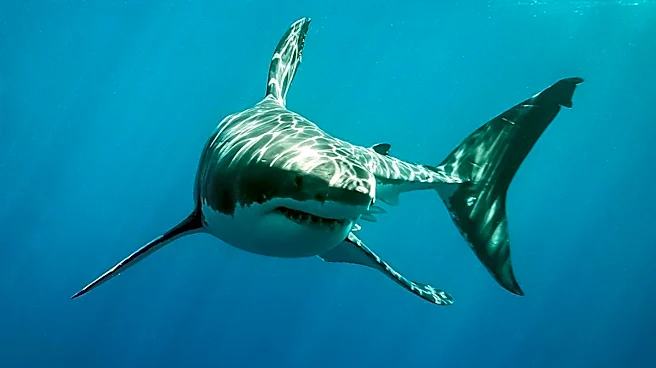
encountering a great white shark, estimated to be up to four meters long. She recounted hearing a scream and seeing a large fin, initially mistaking it for a dolphin. Upon realizing it was a shark, she and others began screaming. When the shark approached her, she decided to punch it to protect her face, resulting in her left forearm being severely injured. The shark then grabbed her left thigh and pulled her underwater. Stewart fought back, punching the shark repeatedly until it released her. She was helped ashore by an elite paddleboarder, Charlie Verco, and received medical attention before being hospitalized. She emerged from her coma approximately 10 days after the incident.
Why It's Important?
This incident highlights the increasing frequency and severity of shark encounters in Australian waters, a trend that scientists attribute to rising ocean temperatures altering shark migratory patterns. The personal and harrowing account from Leah Stewart underscores the immediate and life-altering consequences for individuals involved in such attacks, including severe physical injuries and psychological trauma. The closure of Coogee Beach after the incident also demonstrates the impact on local communities and tourism. The broader context of nearly 1,300 shark incidents and over 260 fatalities in Australia since 1791, including recent fatal attacks on a 12-year-old boy and three divers, emphasizes the ongoing public safety concerns and the need for continued research into shark behavior and mitigation strategies. The story serves as a stark reminder of the inherent risks associated with ocean activities in areas known for shark populations.
What's Next?
Following this incident and other recent shark attacks, authorities in Australia are likely to continue monitoring shark activity and implementing measures to enhance beach safety. This could include increased surveillance, public awareness campaigns, and potentially the deployment of shark deterrent technologies. Scientists will likely continue their research into the effects of rising ocean temperatures on shark migration and behavior to better understand and predict future interactions with humans. For Leah Stewart, the immediate future involves a long and challenging recovery process, both physically and psychologically, as she adapts to life after the amputation and the trauma of the attack. The community will also likely continue to grapple with the balance between enjoying coastal environments and ensuring public safety in the face of evolving marine ecosystems.
Beyond the Headlines
The incident with Leah Stewart delves into the complex relationship between humans and marine wildlife, particularly in the context of environmental changes. The scientific hypothesis linking rising ocean temperatures to altered shark migratory patterns suggests a broader ecological shift that could have long-term implications for coastal communities and marine conservation efforts. This event also raises ethical considerations regarding human intervention in natural habitats and the balance between protecting human life and preserving wildlife. The psychological impact on survivors of such traumatic events, often extending far beyond physical recovery, highlights the need for comprehensive support systems. Furthermore, the story contributes to the ongoing global dialogue about climate change and its tangible effects on ecosystems, prompting a reevaluation of how human activities and environmental shifts intersect to create new challenges and risks.