




What's Happening?
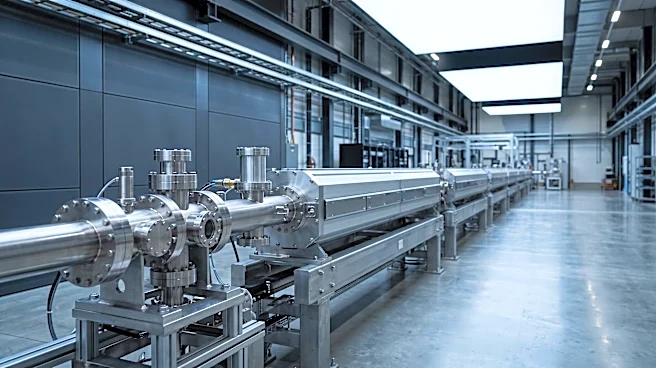
France’s aerospace research agency, ONERA, is undertaking a significant modernization of its space-environment testing facilities in Toulouse. This initiative involves the construction of a higher-power proton accelerator, designed to study how radiation
degrades materials and systems used in spacecraft. The project, named HERMES (High Energies for the Irradiation of Materials with Electrons and protons), aims to renew facilities that have been simulating space radiation environments for over 40 years. The commissioning of these upgraded facilities is anticipated by late 2028. ONERA has awarded the contract for the first proton accelerator to National Electrostatics Corp (NEC) of Middleton, Wisconsin, following an international tender. The HERMES program will eventually comprise five electron and proton accelerators, capable of reaching energies up to 5 megaelectronvolts (MeV), a substantial increase from the current facility's 2 MeV.
Why It's Important?
This modernization effort is critical for the U.S. aerospace industry and its international partners, particularly given the increasing complexity and longevity requirements of space missions. The ability to precisely simulate the effects of radiation on space materials and systems is paramount for ensuring the survivability of spacecraft in Earth orbit and during future exploration missions. The contract awarded to National Electrostatics Corp (NEC) of Wisconsin highlights U.S. expertise in advanced scientific instrumentation and its role in supporting international space research. This collaboration strengthens transatlantic scientific ties and contributes to the global knowledge base for space technology. For U.S. companies involved in satellite manufacturing and space exploration, the enhanced testing capabilities in France could lead to more robust and reliable components, ultimately benefiting the safety and success of their missions.
What's Next?
The immediate next step is the design and manufacture of the new accelerator by National Electrostatics Corp (NEC), with commissioning scheduled for late 2028. French group Kardham is managing the expansion of the bunker that will house the accelerator and overseeing construction. Once operational, the HERMES facilities will provide France with a unique capability in Europe to study, qualify, and improve the radiation resistance of space materials and systems. This will support both civilian and defense space ambitions, including new satellite constellations and future exploration missions. The enhanced testing capabilities are expected to lead to advancements in material science for space applications, potentially influencing international standards and best practices for spacecraft design and construction. U.S. aerospace companies and researchers may seek to utilize or collaborate with these advanced facilities for their own projects.
Beyond the Headlines
The investment in advanced space-environment testing facilities, such as ONERA's HERMES program, reflects a growing global recognition of the challenges posed by the harsh space environment. As orbital activity rapidly expands and ambitions for deep space exploration increase, understanding and mitigating the effects of radiation on materials becomes ever more critical. This project underscores the strategic importance of national sovereignty in space capabilities, ensuring that countries can independently develop and test their space technologies. The collaboration with a U.S. company like NEC also highlights the interconnectedness of the global scientific and technological landscape, where specialized expertise transcends national borders. The long-term implications include the development of more resilient spacecraft, enabling longer missions, reducing failure rates, and ultimately fostering greater innovation and exploration in space, with potential benefits for various industries reliant on satellite technology.