



What's Happening?
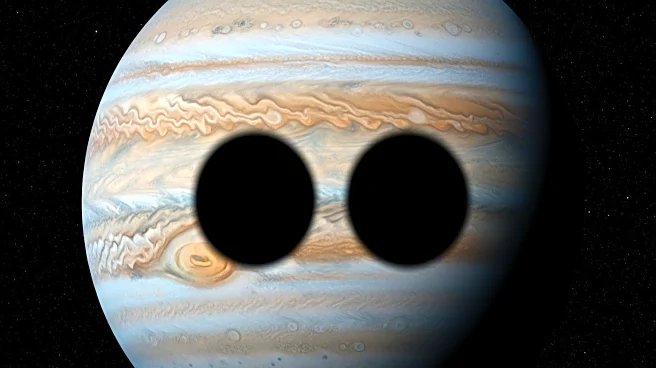
On February 11, 2026, a notable astronomical event will occur as the shadows of Jupiter's moons, Ganymede and Io, transit across the planet's surface. This celestial event will be visible to observers in the eastern half of the United States. Ganymede's
shadow will be seen sliding across Jupiter's cloud tops as darkness falls, with the shadow disappearing just after 8:15 P.M. EST. Following this, Io and its shadow will begin their transit shortly after midnight in the Central time zone, and after 1 A.M. in the Eastern time zone. Io's transit will start at 12:06 A.M. EST, with its shadow following approximately 50 minutes later. The event will conclude with Io's shadow disappearing around 3:10 A.M. EST.
Why It's Important?
This event is significant for both amateur and professional astronomers as it provides a unique opportunity to observe the dynamic interactions of Jupiter's moons. Such transits offer insights into the orbital mechanics and physical characteristics of these celestial bodies. For the general public, it serves as an engaging way to connect with astronomy and the broader universe. The visibility of this event across a large portion of the U.S. makes it accessible to many, potentially sparking interest in space observation and science education.
What's Next?
Following this event, astronomers and enthusiasts will continue to monitor Jupiter and its moons for further transits and celestial phenomena. These observations contribute to ongoing research and understanding of the solar system. Additionally, similar events are anticipated in the future, providing more opportunities for public engagement and scientific study.
Beyond the Headlines
The transit of Ganymede and Io's shadows across Jupiter highlights the intricate dance of celestial bodies within our solar system. It underscores the importance of continued investment in astronomical research and public education. Events like these can inspire future generations to pursue careers in science and technology, fostering a deeper appreciation for the universe.