



What's Happening?
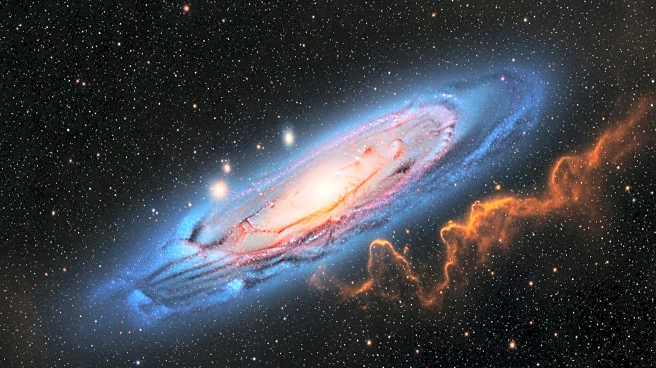
NASA's James Webb Space Telescope has confirmed the existence of a galaxy, MoM-z14, which formed approximately 280 million years after the Big Bang. This discovery pushes the boundaries of observable space closer to the universe's inception. The galaxy's
characteristics, including its brightness and chemical composition, are surprising scientists. MoM-z14 is enriched with heavy elements like nitrogen, which are not typically expected in such early galaxies. This finding challenges existing theories about the early universe, suggesting that the conditions and processes during that time may have been different than previously thought. The telescope's advanced capabilities allow astronomers to observe these distant galaxies, providing direct information about the universe's formative years.
Why It's Important?
The discovery of MoM-z14 is significant as it provides new insights into the early universe's structure and composition. The presence of heavy elements in such an ancient galaxy suggests that the processes of star formation and chemical enrichment occurred more rapidly than current models predict. This challenges existing theories and opens new avenues for research into the universe's early development. The findings could lead to a better understanding of the transition from the universe's initial state to one filled with stars and galaxies. The James Webb Space Telescope's ability to observe these distant galaxies is crucial for advancing our knowledge of cosmic history and the evolution of the universe.
What's Next?
As the James Webb Space Telescope continues its observations, astronomers anticipate discovering more ancient galaxies like MoM-z14. These findings will help refine models of the early universe and the processes that shaped it. The upcoming Nancy Grace Roman Space Telescope is expected to complement Webb's discoveries by providing high-resolution infrared imaging and a wide field of view, potentially increasing the sample size of these early galaxies. This will allow researchers to identify common features and further understand the timeline of cosmic reionization, a period when early stars began to illuminate the universe.
Beyond the Headlines
The discovery of MoM-z14 highlights the importance of advanced astronomical tools in challenging and refining scientific theories. The unexpected chemical composition of the galaxy suggests that the early universe may have hosted supermassive stars capable of producing more nitrogen than previously observed. This raises questions about the nature of star formation and the environmental conditions of the early universe. The findings underscore the dynamic and evolving nature of scientific inquiry, where new data can lead to significant shifts in understanding and open new research directions.