





What's Happening?
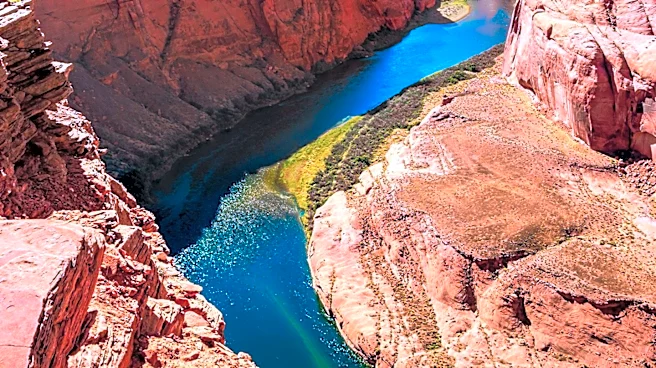
State and Idaho Power Co. officials are making progress on a mitigation plan for the Swan Falls Agreement, aiming to have it in place for the 2027 irrigation season. The 1984 agreement governs the balance of Snake River water use between agricultural
development and Idaho Power's hydroelectricity generation. This year, Snake River flows neared the agreement-specified minimum, prompting the Department of Water Resources to notify over 4,000 trust water users of potential curtailment. However, this plan was scrapped after Idaho Power officials and Governor Brad Little advocated for alternative solutions. Governor Little, in a June 26 letter, urged the Idaho Water Resource Board (IWRB) to find a permanent resolution for trust water right holders willing to mitigate their impacts on flows at Swan Falls Dam. He recommended securing storage water to offset depletion and forming a stakeholder group within the Swan Falls Implementation Group to evaluate long-term solutions.
Why It's Important?
The Swan Falls mitigation effort is critical for ensuring water security and economic stability in Idaho. The agreement directly impacts thousands of trust water users, including irrigators, cities, and businesses, particularly those in food production, who rely heavily on these water rights. Without a clear mitigation plan, these users face the risk of curtailment during periods of low flow, which could severely disrupt agricultural operations, municipal water supplies, and hydroelectric power generation. The collaborative approach involving the IWRB, Idaho Power, and various stakeholders such as the Idaho Dairymen’s Association and groundwater districts, aims to create a 'global solution' that protects all water users. This initiative is particularly vital in addressing the challenges posed by drought conditions and ensuring the long-term sustainability of water resources in the Snake River basin.
What's Next?
The Idaho Water Resource Board (IWRB) is actively meeting with various stakeholders, including agricultural associations, cities, and water user groups, to gather input for the mitigation plan. Following these listening sessions, the IWRB plans to hold a formal meeting with all stakeholders, likely in mid-to-late October, after the harvest season concludes, to facilitate broader participation from irrigators. Idaho Power is keen to establish a plan before the next irrigation season to provide protections for water users. The goal is to find consensus on how to manage trust water rights, potentially involving mechanisms like securing additional reservoir-stored water to offset flow depletion. The successful implementation of this plan will be crucial for preventing future water curtailments and ensuring the equitable distribution of Snake River water.
Beyond the Headlines
The Swan Falls mitigation effort underscores the complex and often contentious nature of water rights management in the Western United States, particularly in the face of increasing climate variability and drought. This situation highlights the delicate balance between competing demands for water—agriculture, energy production, and municipal use—and the necessity of adaptive governance structures. The push for a 'global solution' reflects a recognition that piecemeal approaches are insufficient for long-term water security. This collaborative model, involving diverse stakeholders and state leadership, could serve as a blueprint for other regions grappling with similar water scarcity issues. It also brings to light the ethical considerations of resource allocation and the economic implications for communities heavily reliant on specific water sources, emphasizing the need for sustainable practices and proactive planning.