




What's Happening?
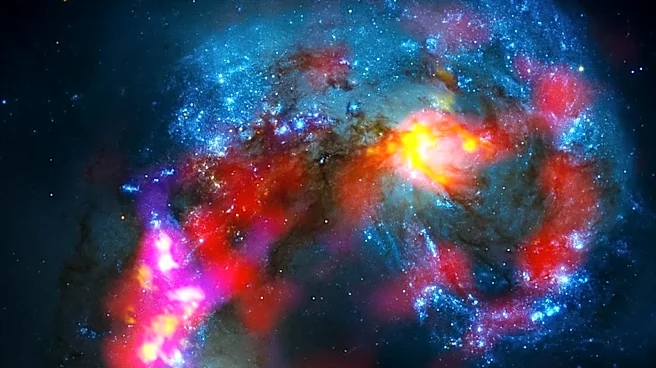
NASA’s Chandra X-ray Observatory has released a new collection of 16 images showcasing galaxies in various stages of their life cycles, from peaceful star factories to cosmic wrecking grounds. These images combine decades of Chandra observations with
data from other observatories, including NASA’s James Webb and Hubble Space Telescopes. While visible light reveals stars and dust, X-rays detected by Chandra highlight violent activities within galaxies, such as gas heated to millions of degrees, stellar remnants, and material energized by growing supermassive black holes. These phenomena are crucial for shaping galaxies and distributing chemical elements into space. The gallery includes examples of spiral, elliptical, and irregular galaxies, illustrating how collisions, intense star formation, and powerful black hole jets influence galactic structure and evolution.
Why It's Important?
This comprehensive collection of images is important because it provides astronomers with a more complete picture of how galaxies form, interact, and change over cosmic time. By combining X-ray data with observations from other wavelengths, researchers can examine the same galaxy in complementary ways, revealing different structures and processes. This multi-wavelength approach is essential for understanding the complex interplay between supermassive black holes, star formation, and galactic mergers. The study of distant galaxies also offers valuable context for understanding our own Milky Way, as researchers cannot observe our galaxy from the outside. These observations help to explain how chemical elements, vital for the formation of new stars, planets, and even life, are distributed throughout the universe through processes like exploding stars and powerful outflows from black holes.
What's Next?
Astronomers will continue to utilize multi-wavelength observations to further unravel the mysteries of galactic evolution. The insights gained from this collection will inform future research into how supermassive black holes influence their host galaxies, the mechanisms behind intense starbursts, and the long-term effects of galactic collisions. The data will also help refine models of galaxy formation and evolution, providing a more accurate understanding of the universe's history and future. Continued collaboration between different observatories, such as Chandra, Webb, and Hubble, will be crucial for building an even more detailed and nuanced picture of the cosmos, potentially leading to new discoveries about the fundamental processes that govern galactic dynamics.
Beyond the Headlines
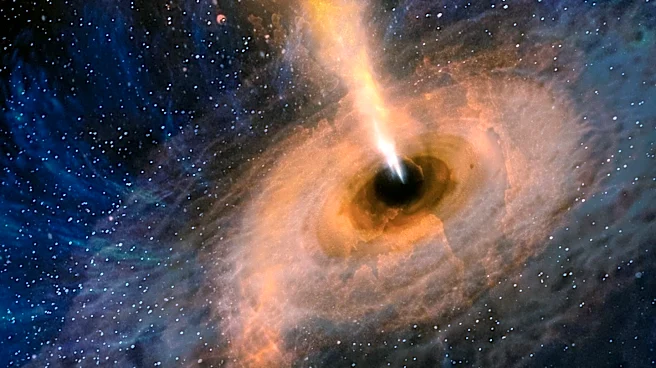
The ability of black holes to reshape galaxies, as highlighted by the Chandra observations, reveals a profound and often destructive force at play in the universe. Supermassive black holes, through their consumption of surrounding material, can become active galactic nuclei, emitting powerful radiation and jets that can heat gas and prevent star formation, effectively acting as a brake on galactic growth. Conversely, galactic collisions, while violent, can also trigger new waves of star formation. This duality of destruction and creation underscores the dynamic and ever-changing nature of the cosmos. The ethical implication lies in our continuous quest to understand our place in this vast and complex universe, recognizing the immense forces that have shaped and continue to shape the cosmic landscape, far beyond human scales and comprehension.