




What's Happening?
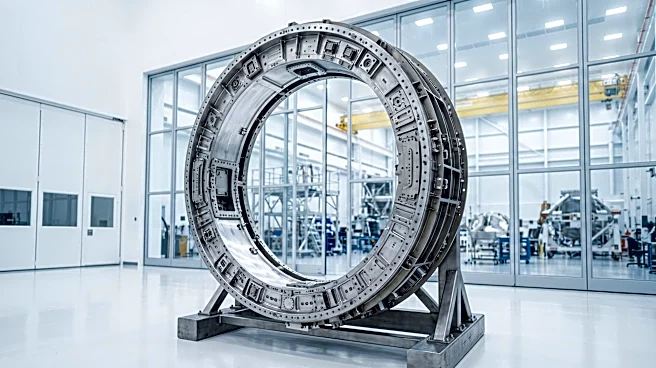
Moog Inc. (NYSE: MOG.A and MOG.B) is commemorating 25 years since its Evolved Secondary Payload Adapter (ESPA) ring completed its Critical Design Review in 2001. This pioneering technology has significantly advanced space rideshare capabilities, allowing
multiple payloads to share a single launch vehicle and thereby broadening access to orbit for commercial, government, and defense missions. The development of the ESPA ring began in 1999 as a collaborative government-industry initiative, culminating in its successful Critical Design Review on January 18, 2001. The ESPA ring efficiently utilizes previously unused volume beneath primary satellites, enabling launch vehicles to carry additional payloads, which has reduced costs and increased mission flexibility for various space operations.
Why It's Important?
The ESPA ring's 25-year legacy underscores its critical role in democratizing access to space. By enabling cost-effective rideshare opportunities, it has significantly lowered the barriers for smaller satellites, technology demonstrations, and commercial constellations to reach orbit. This has fostered innovation within the U.S. space industry, allowing more companies and government agencies to conduct research, deploy services, and enhance national security capabilities. The modular architecture and adaptable interfaces of the ESPA platform have supported a wide range of missions for NASA, the U.S. government, and commercial ventures, making space more accessible and economically viable. Its impact is evident in the proliferation of satellite-based services and the rapid growth of the commercial space sector.
What's Next?
Moog Inc. continues to evolve the ESPA family of configurations, including Standard ESPA, ESPA Heavy, and ESPA Grande, to meet changing payload and mission requirements. The company is focused on advancing spacecraft payload integration and developing adaptable solutions to ensure flexible and cost-effective access to orbit for future space exploration and defense missions. In conjunction with the anniversary, a flight-qualified ESPA ring will be on display at the National Museum of Nuclear Science & History in Albuquerque, N.M., from November 7, 2026, through January 10, 2027, offering the public a chance to see this influential hardware. This ongoing development ensures that ESPA will continue to play a vital role in future space endeavors, supporting both governmental and commercial space initiatives.
Beyond the Headlines
The enduring success of the ESPA ring highlights the power of government-industry collaboration in driving technological innovation. Its development, initiated through a joint effort, created a standard that has profoundly influenced space mission planning and execution. This model of collaboration remains crucial for tackling complex challenges in space exploration and defense. Furthermore, the ESPA ring's adaptability has allowed it to serve not only as a payload adapter but also as a structural foundation for spacecraft buses, demonstrating its versatile design. This adaptability is key in a rapidly evolving space market, where mission requirements and payload sizes are constantly changing, emphasizing the importance of flexible and scalable solutions for long-term success in space. The technology's impact extends to fostering a more competitive and innovative space ecosystem.